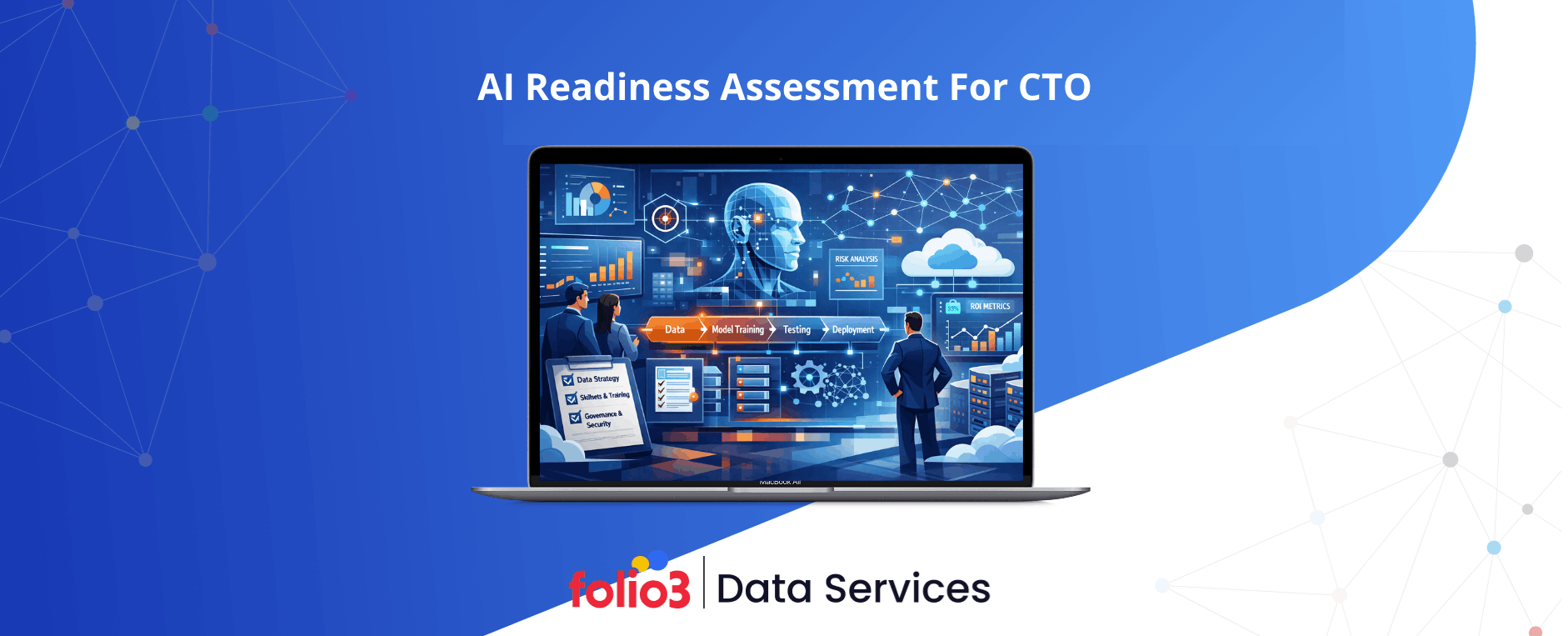

Enterprise AI readiness is the organization’s ability to adopt, scale, and govern AI solutions to deliver measurable business value with managed risk. A rigorous AI readiness assessment evaluates maturity across leadership alignment, data, technology, skills, and governance, highlighting where to invest first. Independent industry research shows that only 32% of organizations are highly ready on data fundamentals, underscoring why structured assessments matter for most enterprises (industry research). The best AI readiness assessment services for enterprises combine strategy-first discovery with deep data diagnostics, platform validation, operating model design, and governance safeguards. In this guide, we present a concise, tried-and-tested framework CTOs can use to benchmark the current state, close critical gaps, and confidently scale AI. This particularly asks for maturity models, phased execution, and measurable outcomes (AI readiness frameworks).
Core Domains of AI Readiness Assessment
A holistic, multi-domain evaluation prevents local optimizations that fail at scale. A maturity radar or matrix clarifies strengths and gaps and is central to industry-leading assessments (AI maturity tool). We recommend assessing five core domains:
- Strategic Alignment & Leadership: AI mapped to business outcomes with executive sponsorship and clear KPIs.
- Data Quality & Lineage: Trusted, well-documented data with provenance and controls.
- Technical Infrastructure & Integration: Cloud-native, scalable platforms, pipelines, and monitoring.
- Skills & Operating Model: The right roles, processes, and partner ecosystem to execute at speed.
- Governance, Risk & Measurement: Policies, controls, audits, and metrics to ensure responsible AI.
Strategic Alignment and Leadership
Strategic alignment connects AI initiatives to prioritized business goals, use cases, and quantifiable KPIs—an area often formalized during AI Readiness Assessment services to ensure early efforts map to real business value. Executive sponsorship is essential to secure funding, remove blockers, and sustain momentum—especially through early uncertainties (C-suite readiness guidance). Leading companies tie pilots to board-visible outcomes (e.g., margin, churn, safety) and establish accountable owners, timelines, and thresholds for success.
Data Quality and Lineage
Data quality is the degree to which data is accurate, complete, timely, and consistent. Data lineage is the ability to trace data’s origin and transformations across its lifecycle. Only 4% of surveyed leaders report their data is truly ready for AI, making proactive scoring, stewardship, and remediation indispensable (industry research). Key assessment focus areas include data catalog coverage, lineage tracking, quality tests, schema-change detection, PII tagging, and role-based access controls.
Technical Infrastructure and Integration
Technical infrastructure encompasses platforms, tools, and pipelines for ingestion, storage, compute, model deployment, and monitoring. Cloud-native architectures with autoscaling compute, IaC, and CI/CD for models accelerate reliability and time-to-insight (AI maturity tool). Integration remains a common barrier—73% of companies report data integration issues between sources, AI tools, and analytics (industry research). Prioritize unified connectors, event-driven pipelines, observability, and model performance/drift monitoring.
Skills and Operating Model
An operating model defines roles, responsibilities, and processes that orchestrate AI efforts across product, data, engineering, and risk. Map current skills, identify gaps, and plan targeted upskilling or strategic partners to cover advanced ML, MLOps, and domain needs (enterprise assessment approach). For safety and velocity, implement risk-tiered approval gates for AI-generated code and outputs, tied to sensitivity and blast radius (AI agent governance).
Governance, Risk, and Measurement
AI governance comprises frameworks, controls, and audits ensuring ethical, compliant, and transparent AI. Core elements include access controls, metadata and retention standards, policy templates, responsible AI guidelines, bias/fairness audits, incident response, and post-deployment monitoring (C-suite readiness guidance). Measurement should go beyond ROI to include trust signals—explainability, fairness, resiliency, and human oversight.
Step-by-Step AI Readiness Implementation Guide for CTOs
Use a phased, outcome-driven approach to reduce risk and accelerate results. Each step clarifies actions, rationale, and benchmarks—maintaining a clear line of sight to business value.
Secure Executive Alignment and Define KPIs
Establish a senior sponsor and define 3–5 top business KPIs with success thresholds before pilots begin (C-suite readiness guidance). Align expectations on milestones and decision gates.
| Business Objective | AI Opportunity | Primary KPI | Baseline | Target | Timeframe | Executive Sponsor |
| Reduce operating cost | Forecast demand to optimize staffing | Cost/Unit | $5.10 | $4.60 | 2 quarters | COO |
| Increase revenue | Next-best-offer personalization | Conversion Rate | 2.5% | 3.2% | 1 quarter | CCO |
| Improve quality | Vision-based defect detection | Defect Rate | 1.8% | 0.7% | 2 quarters | SVP Ops |
Inventory and Score Data Assets
Catalog enterprise data (sources, owners, sensitivity), score data quality and lineage, and classify access levels. Automated scoring and data readiness heatmaps expose quick wins and hotspots (AI readiness frameworks). Visualize maturity via a radar to focus investment where it unlocks the most value.
Recommended artifacts:
- Data inventory with stewardship assignments and sensitivity tags
- Quality scorecards (accuracy, completeness, timeliness, consistency)
- Lineage maps across ingestion, transformation, and consumption
- Access model (RBAC/ABAC) and exception workflows
Validate Infrastructure and Integration Capabilities
Audit connectors, ingestion reliability, storage governance, autoscaling, CI/CD, observability, and drift detection for AI workloads (AI agent governance). Benchmark against peers; only 29% of enterprises report well-integrated AI and analytics toolchains (industry research).
| Checkpoint | Why It Matters |
| Unified connectors and CDC | Reduces latency and breaks |
| Cloud autoscaling and spot strategy | Optimizes cost/performance |
| Model CI/CD with canary deploys | Safe, repeatable releases |
| Centralized feature store | Consistency across models |
| Data/model observability | Detects anomalies and drift |
| Secrets management and KMS | Prevents credential sprawl |
Assess Skills, Roles, and Control Mechanisms
Map required roles (product, data science, ML engineering, MLOps, data governance, security, domain SMEs), gauge capacity, and create a hiring or upskilling roadmap (enterprise assessment approach). Clear ownership across these roles is essential to producing AI-Ready Data that can be trusted in production. Establish risk-tiered approval workflows for AI-generated code, data transformations, and LLM outputs, with human-in-the-loop and rollback plans (AI agent governance).
Pilot with Clear Metrics and Approval Gates
Select high-impact, narrow-scope problems with clean data access and clear owners. Instrument both business and fairness metrics; define go/no-go gates and rollback criteria before deployment (AI case studies). Real-world programs show rapid payoffs—Walmart reported $75M savings in one year through logistics AI, and BMW saw a 60% defect reduction via computer vision (AI case studies).
Scale AI with Governance and Continuous Audits
Codify policies, automate compliance checks in pipelines, and schedule recurring audits and feedback loops (C-suite readiness guidance). Organizations often rely on data governance services at this stage to operationalize controls across teams. A practical governance loop: set policy → encode controls and tests → monitor in production → review incidents and metrics → refine policy. Ensure transparent reporting to executive sponsors and risk committees.
Operational Best Practices and Quick Wins
- Turn on schema-change alerts in your ingestion/ELT stack and add contract tests to halt bad data before it impacts downstream processes.
- Apply RBAC to critical/PII datasets; auto-provision access by role, and expire temporary grants.
- Embed automated policy, fairness, and quality checks in CI/CD; require approvals for high-risk changes.
- Track model/data SLAs and alert on drift, latency, and error spikes.
- Stand up a lightweight model registry and feature store to remove duplication and speed reuse.
- Maintain a decision log for AI use cases to record assumptions, owners, and review dates (prevents orphaned pilots).
Schema-Change Alerts and Data Tests
Enable schema-change alerts (e.g., with dbt or Fivetran) and contract tests to stop pipelines on breaking changes (AI readiness frameworks). Integrate validation into existing workflows so failures are caught early and surfaced to the right owners. For teams leveraging cloud data platforms, Snowflake implementation services can help set up these alerts and tests efficiently, ensuring consistent governance across datasets.
Role-Based Access Controls on Key Datasets
Role-based access control limits data exposure based on job responsibilities and risk. Convert critical datasets to RBAC, enforce least-privilege by default, and automate reviews to meet audit and compliance requirements.
Embedded Compliance in CI/CD Pipelines
Bake policy, fairness, and quality checks into CI/CD so that every model or prompt change is tested and governed (AI agent governance). Include rollback procedures, artifact provenance, and automated gates for AI-generated assets.
From data auditing to CI/CD governance and model deployment, Folio3 provides end-to-end AI readiness services to help CTOs scale AI initiatives confidently.
Measuring Success and Realizing ROI from AI Readiness
Set pre-AI baselines and track 3 to 5 business-centric metrics per initiative, along with reliability, fairness, and adoption. When AI workloads are deployed on governed data platforms such as Snowflake’s AI model, teams can more consistently attribute outcomes to production use cases. Case studies report meaningful impact, including Walmart’s $75M in logistics savings and BMW’s 60% defect reduction after computer vision deployment (AI case studies).
| Metric | Before | After | Outcome |
| Forecast error (WMAPE) | 18% | 10% | Lower stockouts, reduced expedite fees |
| Cost per transaction | $0.42 | $0.33 | Opex savings and scale |
| Defect rate | 1.8% | 0.7% | Higher yield, fewer returns |
| SLA breaches (per month) | 12 | 3 | Improved reliability and trust |
| Fairness disparity | 9% | 3% | Reduced risk and stronger governance posture |
Building a Tailored AI Roadmap Based on Assessment Insights
Synthesize findings across domains into a sequenced roadmap: stabilize data foundations, modernize priority processes, close security/compliance gaps, then scale platforms and reusable components (opportunity assessment). Use a rolling 90-day plan for quick wins and a 12- to 18-month view for platform and operating model changes. Revisit quarterly to align with evolving regulations and strategy. Where depth is needed, engage specialists like Folio3 Data who offer AI data readiness services, data strategy consulting, and platform expertise across Snowflake and Databricks to accelerate time-to-insight with a governance-first approach.
Frequently asked questions
How can CTOs evaluate organizational readiness for AI adoption?
Assess leadership support, data maturity, technical infrastructure, skills, and governance using a structured maturity model to pinpoint strengths and gaps.
What are the typical phases in an AI readiness assessment?
Most programs move from current-state assessment and strategy to building data/technical foundations, then to workflow redesign and scaling with governance.
How should enterprises govern AI risk and maintain ethical standards?
Embed policy controls, access restrictions, fairness audits, and continuous monitoring within a formal governance framework aligned to industry standards.
What KPIs are essential to track AI readiness progress and ROI?
Track process efficiency, error reduction, cost savings, uptime, model fairness, and direct business impact associated with each AI use case.
Which tools or checklists help benchmark AI maturity effectively?
Use maturity matrices, readiness checklists, and interactive assessment tools to benchmark data, skills, and technology, prioritizing improvements accordingly.
Conclusion
Enterprise AI readiness is no longer just a technical checkbox; it is a strategic imperative for organizations that want to innovate confidently and scale AI responsibly. When your leadership is aligned, your data is trusted, your infrastructure is robust, and your teams have the right skills, AI initiatives deliver measurable business impact while minimizing risk. By systematically assessing maturity, identifying gaps, and following a phased roadmap, organizations turn fragmented capabilities into a repeatable engine for AI-driven growth.
Folio3 Data Services helps enterprises navigate this complexity with practical, governance-first AI readiness assessments. Our experts evaluate your leadership alignment, data quality, technical infrastructure, skills, and governance practices to create a clear, actionable roadmap. Whether you are preparing for your first AI pilot or scaling enterprise-wide AI, we provide the frameworks, tools, and guidance to ensure your organization is fully prepared to harness AI safely and effectively.