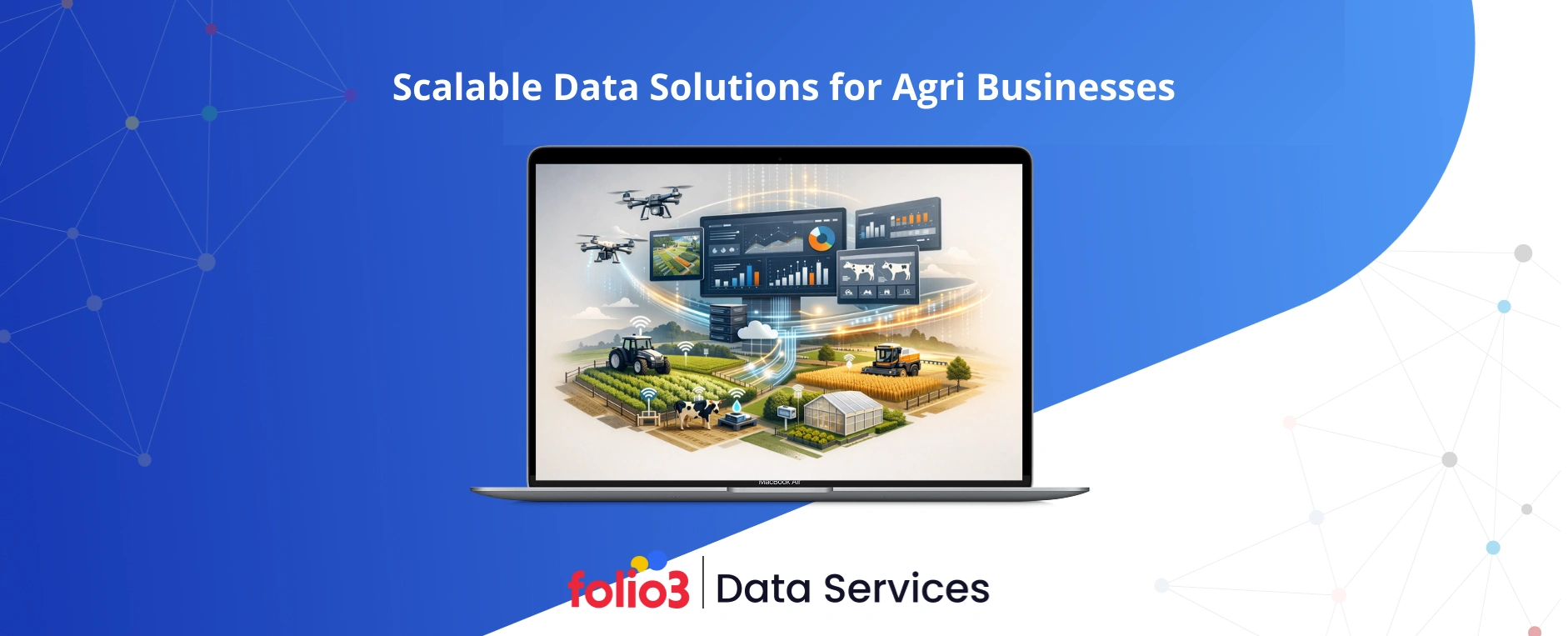

Data is now a core crop input. In 2026, the agribusinesses that win will run on scalable data solutions that unify telemetry from fields, optimize operations, and power predictive decisions—from yield forecasts to sustainability reporting. Below are the 10 foundational capabilities every agri enterprise needs, with clear definitions, integration guidance, and ROI levers. Throughout, we reference proven practices from the modern data stack and agriculture leaders to help you move faster with confidence. The throughline: build a flexible, governed, cloud-native foundation that scales with your acres, devices, seasons, and partners—without vendor lock-in or runaway costs.
1. Folio3 Data’s Custom Scalable Data Engineering Platform
Folio3 Data brings a consultative, end-to-end approach that unifies soil sensors, machinery telemetry, ERP, weather, satellite, and partner data into a governed, analytics-ready foundation. We modernize legacy systems and accelerate time-to-insight using cloud-native, modular architectures on Snowflake, Databricks, and BigQuery—paired with robust governance, observability, and cost controls to ensure your data products scale predictably as part of enterprise agriculture data analytics services.
Our platform is built for agriculture’s realities: seasonality, high-frequency telemetry, geo-spatial features, and regulatory reporting. We design with open standards and API-first integrations to avoid lock-in while optimizing for performance and TCO. From architecture and ingestion to feature stores, embedded analytics, and secure sharing, we deliver measurable outcomes—like faster decisions, reduced waste, and improved yield consistency—through custom data engineering, scalable architecture, and agriculture data solutions that align with your operating model. Explore our approach and use cases in agriculture data analytics services at Folio3 Data.
Key platform components mapped to common agri data pain points:
| Platform component | What it solves | Agri examples | ROI driver |
| Ingestion & connectors | Fragmented data sources | Soil sensors, machine CAN bus, ERP, weather, satellite | Reduced manual prep; more complete data |
| Orchestration (batch/stream) | Unreliable updates | CRON, 15‑min micro-batches, CDC for ERPs | Fresher insights; fewer pipeline failures |
| Lakehouse & warehouse | Siloed analytics | Unified layer for telemetry + operations | Faster queries; lower storage/compute TCO |
| Governance & catalog | Low trust, slow audits | Lineage, ownership, policies | Compliance readiness; faster onboarding |
| Data quality & observability | Hidden errors | Anomaly checks, SLAs, incident alerts | Fewer bad decisions; faster MTTR |
| Feature store & ML ops | Slow model iteration | Yield, NDVI features, input optimization | Reusable features; traceable models |
| BI & embedded analytics | Insight bottlenecks | Field dashboards, inventory, fulfilment | Self-service; decisions in workflow |
| Privacy & security | Regulatory risk | RBAC, masking, encryption, auditing | Reduced breach/compliance costs |
| FinOps & cost controls | Unpredictable spend | Usage caps, auto-suspend, compression | Predictable ROI; scaled efficiently |
2. Cloud Data Warehouse and Lakehouse Solutions for Unified Agri Data
A data warehouse is a centralized repository for structured data optimized for fast querying and reporting. A lakehouse blends the scale and flexibility of a data lake with the performance and governance of a warehouse, enabling both BI and data science on one platform. As the 2026 data stack consensus notes, the lakehouse trend merges data warehouse and data lake benefits into unified platforms for speed and simplicity (2026 modern data stack blueprint).
In agriculture, these layers aggregate IoT sensor streams, yield records, farm operations, input purchases, and weather telemetry in one governed store—accelerating modeling and decisions. They also enable agricultural supply chain visualization, letting teams map inputs, outputs, and logistics flows across farms, warehouses, and distributors to spot bottlenecks and optimize delivery. Cloud data warehouses enable ad hoc queries, operational dashboards, and data science at scale, while a lakehouse allows direct training of models on large, semi-structured, and spatial datasets. Modern data stack adopters report 70% faster query performance and about 50% lower TCO when paired with effective modeling and workload management (data transformation statistics). Watch storage, retention, and partitioning: costs scale with volume and concurrency, so model hot vs. cold data and sampling strategies up front.
For agribusiness examples, precision irrigation and soil telemetry platforms like CropX illustrate how unified, near-real-time sensor data translates into water savings and yield protection at enterprise scale (CropX agribusiness).
3. ETL, ELT, and Connector Platforms for Reliable Data Integration
ETL (Extract, Transform, Load) moves data from sources to a target after transforming it; ELT (Extract, Load, Transform) loads first, then transforms inside the warehouse/lakehouse for agility and scale. Managed pipelines and over 200 connectors ingest sensors, satellites, and ERP data reliably, with scheduling and CDC support—crucial for seasonally variable, multi-tenant agri environments. Modern platforms now often incorporate IoT sensor data pipelines, enabling real-time ingestion of high-frequency farm telemetry like soil moisture, weather stations, and machinery readings.
Best practices:
- Scheduling flexibility: use CRON and 15-minute micro-batches for operational freshness; stream where latency matters.
- Change data capture (CDC): keep ERP and transactional systems synced for inventory and fulfillment accuracy.
- Automated transformations: templatize unit normalization, geo joins, and time alignment.
- Column-level controls: enforce schema, units, and quality constraints that reflect agronomy realities (e.g., moisture %, pH ranges).
4. Data Catalogs and Metadata Discovery to Accelerate Reuse and Compliance
A data catalog is an indexed inventory of enterprise data assets, documenting lineage, ownership, and quality so teams can find and trust data quickly. Data catalog tools like Atlan, Alation, and Collibra centralize data inventory and lineage for better governance across complex stacks (2026 modern data stack blueprint). For agribusinesses handling PII, traceability, and sustainability reporting, robust metadata shortens audits and speeds cross-team collaboration. Companies using breeding analytics outsourcing can ensure consistent data formats, traceable lineage, and quality control when sharing datasets with third-party service providers.
Core catalog features to prioritize:
- Search and filtering across schemas, tags, and business terms
- Automated discovery, lineage, and quality scoring
- Role-based security and policy enforcement
- Request workflows for access, changes, and certifications
Governance and metadata markets are expanding rapidly, with data governance projected to grow from $4.44B to $18.07B by 2032 (18.9% CAGR), reflecting enterprise demand for trust and compliance at scale (data transformation statistics).
5. Data Quality and Observability Platforms for Trustworthy Analytics
Data quality platforms validate, clean, and monitor accuracy and consistency; observability adds end-to-end pipeline health, lineage, and incident management. Data quality and observability platforms such as Monte Carlo and Great Expectations monitor pipeline reliability and detect anomalies before they impact production decisions (2026 modern data stack blueprint).
A pragmatic rollout:
- Automated quality checks on critical tables (freshness, nulls, ranges, schema drift).
- Anomaly detection on key KPIs (yield per acre, moisture, input application rates).
- Reliability dashboards with SLAs and lineage to speed root-cause analysis.
- Integration alerts in Slack/Teams and ticketing for rapid remediation.
Control observability costs with compression, smart sampling, or usage caps to avoid noise and budget surprises (2026 cloud predictions).
Feature comparison at a glance:
| Platform | Strengths | Deployment | Scale fit | Notable |
| Monte Carlo | End-to-end data observability, lineage, incident workflows | SaaS | Enterprise | Broad connectors; SLA tracking |
| Great Expectations | Open-source validation, flexible tests | OSS/SaaS | Team→Enterprise (with orchestration) | Strong for rule-based checks |
| Soda | Data quality checks, monitoring | SaaS/OSS | Mid-market→Enterprise | Lightweight setup; good alerting |
6. Business Intelligence and Embedded Analytics for Operational Insights
Business intelligence turns raw data into visual, interactive insights for daily decisions. In 2026, embedded analytics will increasingly surface contextual insights inside business applications, reducing swivel-chair analysis and driving adoption—a shift already visible across leading agritech data and analytics companies building analytics directly into grower, ERP, and operations platforms (2026 modern data stack blueprint). Microsoft Power BI alone offers 160+ connectors and flexible deployment options; pricing starts with Pro at $14 per user per month, with Premium from $5,000 per month for enterprise-scale capacity (best data analysis tools 2026).
High-value agri use cases:
- Field performance dashboards with weather overlays for agronomists
- Inventory, pricing, and claims analytics inside ERP and grower portals
- Real-time logistics and cold-chain status for perishable flows
Built-in AI features (e.g., Copilot) enable natural-language queries and auto-summarization, extending insights to non-analysts. For finance and farm reporting, tools like Figured’s Reporting Studio show how role-based templates accelerate monthly and seasonal decision cycles (Figured reporting).
7. Feature Stores and Machine Learning Platforms for Yield Prediction
A feature store is a central repository for storing, reusing, and versioning model input variables, ensuring consistency between training and serving. ML platforms to integrate with the stack include AWS SageMaker, Google Vertex AI, and Azure ML (2026 modern data stack blueprint).
A typical flow:
- Collect features from lakehouse (e.g., NDVI, rainfall, GDD, soil moisture, input rates).
- Register features with metadata and access policies.
- Train, validate, and version models; track lineage and performance.
- Deploy real-time or batch predictions; monitor drift and fairness.
For agri applications—yield prediction, input optimization, pest/disease risk—feature stores reduce duplication, speed iteration, and improve regulatory traceability. Coupled with real-time herd analytics dashboards, these platforms enable livestock operators to monitor animal health metrics, feeding patterns, and environmental conditions alongside crop predictions, delivering a unified view for operational and strategic decisions. Industry case studies show predictive analytics improving underwriting and risk management for growers (Growers Edge) and unlocking scalable insights in legacy agri stacks (scalable predictive analytics case).
8. Specialized Data Stores for Time-Series, NoSQL, and Spatial Analytics
Specialized data stores add performance and modeling advantages for particular workloads:
- Time-series databases optimize ingest and queries for temporal measurements like sensor data.
- NoSQL databases handle semi-structured data at scale with flexible schemas.
- Graph databases model relationships, ideal for supply chain traceability and agronomic networks. Specialized stores: use NoSQL (MongoDB, Cassandra) for flexible models and high-performance needs. Graph databases like Neo4j excel at analyzing relationships between data points (2026 modern data stack blueprint).
When to choose what:
| Store type | Use when | Pros | Cautions | Examples |
| Time-series | High-frequency telemetry (soil, weather, equipment) | Fast writes; window functions | Cardinality management | InfluxDB, TimescaleDB |
| NoSQL (KV/Doc/Wide) | Flexible schemas; high throughput APIs | Horizontal scale; low-latency | Eventual consistency, modeling discipline | DynamoDB, MongoDB, Cassandra |
| Graph | Traceability, network analysis, fraud | Relationship queries; path finding | Different query paradigm | Neo4j, Amazon Neptune |
| Spatial extension | Geospatial joins/rasters | Native GIS, indexing | Storage-heavy rasters | PostGIS, BigQuery GIS |
9. Data Privacy and Security Tools for Compliance and Risk Management
Data privacy safeguards sensitive information; compliance aligns with regulations like GDPR, CCPA, and India’s DPDP Act. Data privacy and security (masking, encryption, RBAC) must align with GDPR, CCPA, and India’s DPDP Act and be audit-ready across ingestion, storage, and sharing layers (2026 modern data stack blueprint). Typical workflows include PII masking in shared datasets, comprehensive audit logging, tiered role-based access control, and encryption in transit and at rest. Organizations using data pipeline services for livestock feed management can ensure that telemetry and operational data flow securely while meeting regulatory and reporting requirements.
Adopt open standards (OAuth, OIDC, SCIM), automate evidence collection for audits, and centralize policy-as-code. Sustainability and Scope 3 reporting also benefit from standardized, verifiable data pipelines (scalable sustainability data).
10. No-Code and Low-Code Analytics Layers to Empower Agronomists and Staff
No-code/low-code platforms let users build apps, workflows, and reports via drag-and-drop interfaces—without deep coding. The impact is tangible: 70% of IT teams report improved collaboration after adopting no-code tools, 90% of users say their company grew faster thanks to accelerated delivery, and organizations see roughly 40% development cost savings (no-code analytics guide).
Practical agri wins:
- Agronomists compose crop KPI trackers and alerting workflows.
- Supply chain teams prototype dashboards for forecast vs. actuals.
- Field ops build mobile data capture and inspection apps.
Core capabilities to seek: visual design, direct data integration, automation (notifications/approvals), user permissioning, and versioning. For adoption advice, see patterns that encourage farmers to engage with big data practically (encouraging big data in agriculture).
Leverage Folio3’s expertise in cloud-native architecture, feature stores, and low-code analytics to transform raw farm data into operational and strategic insights.
Frequently Asked Questions
What are the benefits of using a cloud data warehouse in agriculture?
Cloud data warehouses consolidate farm, operational, and supply chain data, enabling faster analysis, easy scaling, and real-time insights that enhance decision-making in agriculture.
How can data quality platforms prevent errors in agri business decisions?
Automated data quality platforms validate and monitor incoming data streams, identifying inconsistencies or anomalies before they can affect analytics or operational decisions in agriculture.
Why is no-code analytics important for supply chain teams in agriculture?
No-code analytics empower supply chain teams to rapidly build dashboards and insights themselves, reducing delays and freeing IT staff for more complex projects.
How do specialized data stores improve telemetry and spatial data analysis?
Specialized data stores—such as time-series and graph databases—are optimized for high-frequency sensor inputs and spatial relationships, delivering faster, more relevant analytics in complex agricultural environments.
What steps can agribusinesses take to ensure data privacy and compliance?
Agribusinesses should implement encryption, role-based access controls, audit logs, and PII masking to safeguard sensitive data and remain compliant with evolving industry regulations.
Conclusion
In 2026, scalable data solutions are no longer optional for agribusinesses. From unified lakehouse platforms and reliable pipelines to governed analytics, ML, and no-code tools, these ten capabilities form a practical blueprint for turning raw agricultural data into consistent yields, lower costs, and compliant growth. By building a flexible, cloud-native, and well-governed data foundation, agri enterprises can adapt to seasonality, scale with confidence, and make faster, smarter decisions across the entire farm-to-food value chain.
Folio3 Data Services helps agribusinesses put this blueprint into action. With deep agriculture domain expertise, We design and deliver end-to-end data platforms that unify field telemetry, IoT, ERP, weather, and satellite data into analytics-ready systems. Through scalable architecture, strong governance, and AI-driven insights, We enable agri enterprises to reduce waste, improve yields, and achieve measurable ROI from their data investments.