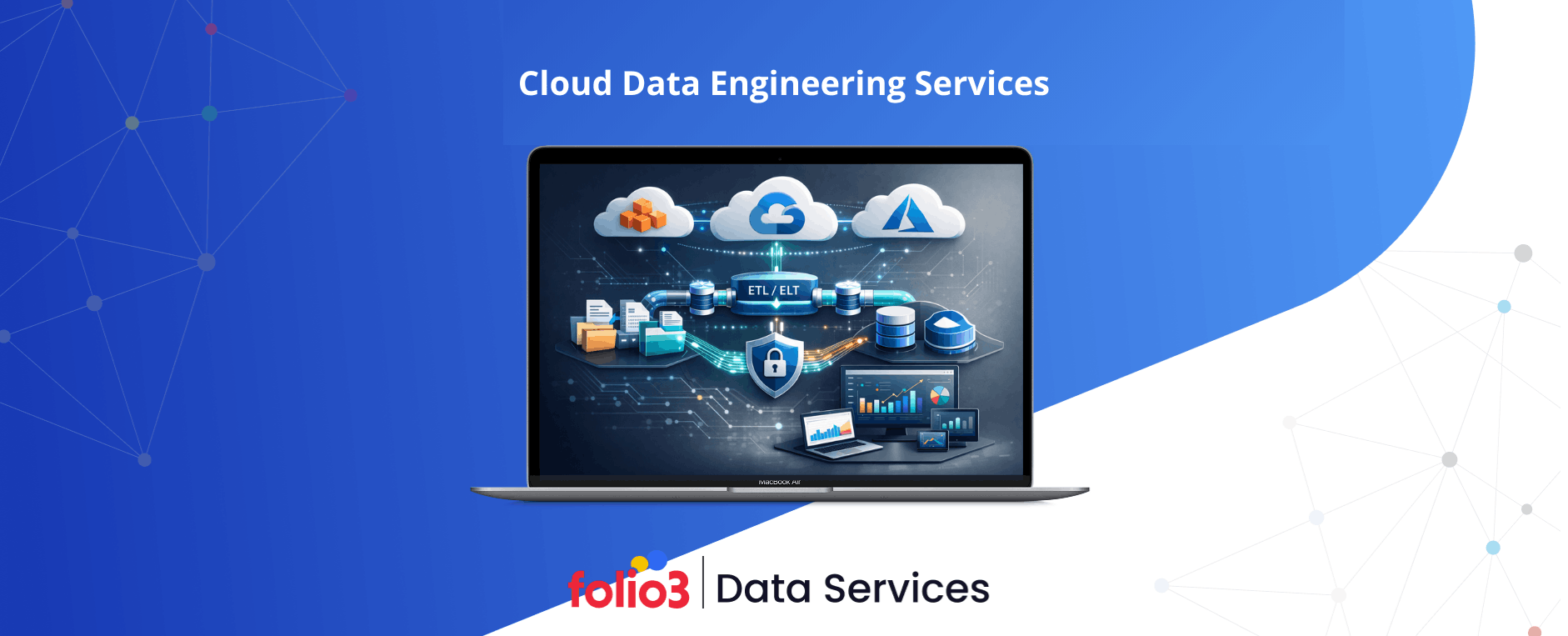

Cloud data engineering in 2026 is defined by AI-enabled analytics, real-time pipelines, and pragmatic multi-cloud strategies that favor agility over lock-in. As of 2025, an estimated 94% of enterprises use cloud services, underscoring how platform choices now directly influence time-to-insight, governance, and cost control, according to a 2026 cloud engineering trends analysis.
The top 10 services shaping outcomes this year span modern warehouses (Snowflake, BigQuery), lakehouse architectures (Databricks), orchestration (Airflow/Composer), serverless integration (AWS Glue), unified batch/stream processing (Dataflow/Beam), hybrid integration (Azure Data Factory), cloud data lakes (AWS Lake Formation, Azure Data Lake), data governance (Collibra, Alation), data observability tooling, and cloud-native ML platforms (SageMaker, Vertex AI, TensorFlow). Below, we explain how to evaluate, combine, and operationalize them for measurable ROI.
Strategic Overview
Cloud data engineering services bring together managed platforms and tooling to ingest, transform, govern, and activate data for analytics and AI at scale. Executives are prioritizing:
- AI enablement: feature stores, vector search, and real-time ETL to feed retrieval-augmented generation and ML.
- Multi-cloud pragmatism: best-of-breed tools across clouds with portable orchestration and open formats.
- Cost and governance by design: FinOps paired with lineage, policies, and observability baked into every pipeline.
Folio3 Data operates as a strategic, hands-on partner focused on Snowflake, Databricks, and BigQuery—aligning platform selection with business goals, reducing operational toil through automation, and accelerating value with AI-ready architectures.
1. Folio3 Data Engineering Services
Folio3 Data helps mid-to-large enterprises modernize data estates end-to-end: cloud platform selection and architecture, secure landing zones, pipeline design (batch/streaming), migration and consolidation, and embedded AI solutions that turn data into decisions. Our certified teams start with discovery and rapid proofs of concept, then co-develop a transparent delivery roadmap tied to tangible KPIs.
- Consulting and architecture: cloud data architectures, data mesh/domain designs, and performance baselines, supported by our architecture services practice (see Architecture Services).
- Pipelines and integration: modular ETL/ELT, CDC, streaming, dbt/Spark jobs, and cross-cloud orchestration (see Data Pipeline Services).
- Modernization and migration: legacy EDW offloads, Hadoop retirement, and cloud landing zones (see Enterprise Data Modernization).
- AI and BI acceleration: semantic layers, vector-enabled stores, and governed self-service analytics.
Core delivery spans Snowflake, Databricks, BigQuery, and hybrid multi-cloud. Explore our Snowflake consulting for data engineering and broader data engineering services.
2. Snowflake and Google BigQuery
Cloud data warehouses like Snowflake and BigQuery store and analyze structured and unstructured data at scale, offering on-demand scalability, cost efficiency, and high performance for data processing, as outlined in the Top 10 Data Engineering Solutions for 2026. Both separate storage and compute, provide elastic scaling, and minimize operations through serverless or near-operatorless models. They support a wide range of workloads: interactive analytics, governed data sharing, data science integrations, and ML via SQL or native services.
Best-fit use cases:
- High-performance analytics with variable concurrency and predictable SLAs.
- Regulated environments needing strong access controls and data sharing controls.
- Deep BI integrations (e.g., Looker, Power BI, Tableau) and SQL-first data teams.
3. Databricks Lakehouse Platform
A lakehouse platform unifies data lakes and warehouses to deliver scalable storage with transactional analytics in one system. Databricks couples Apache Spark with Delta Lake for reliable ETL, ACID transactions, schema enforcement, and time travel, with strengths across ML, streaming, and mixed workloads. Industry overviews of data engineering companies often position Databricks at the center of enterprise data modernization services, particularly for organizations consolidating fragmented analytics stacks and legacy platforms.
Why it stands out:
- Unified architecture reduces duplication between lakes and warehouses.
- Collaborative notebooks and ML runtime accelerate experimentation to production.
- Strong fit for data products spanning structured tabular, semi-structured logs, and unstructured media.
4. Apache Airflow and Cloud Composer
Orchestration ensures that complex, interdependent data pipelines run reliably and on schedule using tools like Apache Airflow and Cloud Composer. Airflow’s open-source model provides flexible DAG-based scheduling, extensible operators, and community plugins. Cloud Composer offers a managed alternative with reduced infrastructure overhead and GCP-native integrations.
Common scenarios:
- Hybrid ETL/ELT automation across warehouses, data lakes, and SaaS APIs.
- Cross-platform dependencies (e.g., trigger a Databricks job after a BigQuery task).
- Cost trade-offs: self-managed for maximum control and lower license costs vs. managed for faster time-to-value and fewer ops.
5. AWS Glue Managed ETL Service
ETL/ELT tools automate extraction, transformation, and loading across diverse data sources to streamline data preparation. AWS Glue brings a serverless, auto-scaling ETL/ELT engine with data crawlers for schema inference, a central Data Catalog, and seamless integration with S3, Redshift, and Lake Formation. It’s commonly used within broader data transformation services initiatives where teams need to standardize schemas, clean raw inputs, and prepare analytics-ready datasets at scale.
When to choose serverless ETL:
- Spiky or unpredictable workloads needing automatic scale.
- Lean teams prioritizing managed governance and lower ops burden.
- Compliance scenarios that benefit from native IAM, encryption, and auditability.
6. Google Dataflow and Apache Beam
Google Dataflow (built on Apache Beam) delivers a single programming model for both batch and streaming data, providing autoscaling for real-time ETL, as detailed in GCP services for data engineers. Reference pattern: Pub/Sub → Dataflow → BigQuery for real-time ETL. This unified model supports late data handling, windowing, and exactly-once semantics—ideal for IoT telemetry, fraud detection, and real-time AI, and commonly adopted within modern data architecture services that prioritize streaming-first designs.
Why it matters for AI:
- Real-time feature pipelines for MLOps.
- Low-latency streams for retrieval-augmented generation.
- Scalable batch reprocessing with the same code used for streaming.
7. Azure Data Factory for Hybrid Integration
Hybrid integration connects on-premises, multi-cloud, and SaaS data sources for unified analytics. Azure Data Factory (ADF) offers a low-code visual interface, a rich library of connectors, integration runtimes for on-prem connectivity, and orchestration that fits naturally within Microsoft-centric estates.
Where ADF excels:
- Lift-and-shift from SSIS and legacy Microsoft BI.
- Coordinating data movement to Azure Synapse, Fabric, or Data Lake.
- Hybrid controls for organizations transitioning to cloud at staged pace.
8. AWS Lake Formation and Azure Data Lake
Data lakes such as AWS Lake Formation and Azure Data Lake are large-scale repositories for raw data, enabling organizations to standardize storage, access, and lifecycle management. Benefits include flexible file formats (Parquet, Avro), fine-grained access control, and rapid onboarding for analytics and ML—areas where data lake consulting often helps teams design the right zones, policies, and cost controls from the start.
Key scenarios:
- Staging raw sensor and clickstream data before curation.
- Building multi-modal stores for AI (text, images, embeddings).
- Policy-driven zones (raw, curated, trusted) to reduce rework and risk.
9. Data Governance Platforms: Collibra and Alation
Platforms like Collibra and Alation manage metadata, lineage, and enforce data quality and access control to help ensure regulatory compliance and analytics trust. They centralize definitions, automate stewardship workflows, and make data discoverable without sacrificing control.
Comparison of capabilities and alignment to enterprise needs:
- Metadata cataloging: business glossary, technical metadata, and search that scales to thousands of assets.
- Policy and access: approval workflows, role-based controls, and audit trails for compliance reporting.
- Lineage and impact: column-level lineage and change impact analysis for safe releases.
- Quality signals: rules, checks, and scorecards visible to analysts and owners.
| Capability | Collibra Focus | Alation Focus | Best Fit |
| Business glossary | Strong governance workflows | User-friendly curation and adoption | Regulated industries with formal stewardship |
| Technical lineage | Deep integration with ETL/ELT tools | Broad connectors for warehouses/BI | Complex, cross-platform data estates |
| Policy & access | Robust policy modeling and approvals | Practical policy linking to docs/usage | Audit-heavy environments |
| Analyst experience | Governance-first, structured onboarding | Search-centric, rapid discovery | Self-service analytics at scale |
10. Machine Learning Platforms: SageMaker, Vertex AI, TensorFlow
AI/ML platforms such as AWS SageMaker, Vertex AI, and TensorFlow provide tools to build, train, and deploy machine learning models at scale. They bridge data engineering and MLOps with features like managed training, model registries, endpoints, feature stores, pipelines, and drift monitoring—often sitting downstream of Snowflake data engineering workflows that prepare governed, analytics-ready features.
Enterprise highlights:
- SageMaker: broad MLOps tooling, managed feature store, and autoscaling endpoints in AWS estates.
- Vertex AI: integrated pipelines, BigQuery ML, and seamless GCP data services interoperability.
- TensorFlow: open-source framework for custom modeling across clouds, often wrapped by managed services.
Data Observability and Testing Tools
Data observability tools like Datafold detect anomalies, compare datasets, and reduce production data errors, supporting reliability engineering, as noted in an industry overview. Integrating observability and automated tests into pipelines shortens time to resolution, strengthens SLAs, and enforces data contracts between producers and consumers.
Core observability functions checklist:
- Freshness and volume monitoring
- Schema change detection
- Data quality tests (nulls, ranges, distributions)
- Lineage-aware alerting
- Regression diffing across environments
- Incident routing and ownership
| Function | Why it matters |
| Freshness/volume checks | Catch stalled jobs and missing data |
| Schema change alerts | Prevent breaking downstream reports |
| Quality rules & SLAs | Ensure reliable analytics and AI flows |
| Lineage-aware alerts | Speed root-cause analysis |
| Data diffs & tests | Safeguard releases and migrations |
Feature Trade-offs and Performance Considerations
Choosing the right stack involves balancing operations, flexibility, and performance. Managed warehouses (Snowflake/BigQuery) minimize operations and deliver predictable performance; lakehouse platforms (Databricks) offer maximal flexibility for mixed data types and advanced ML. Serverless autoscaling reduces idle costs but can obscure tuning levers; dedicated clusters offer fine control with higher ops overhead. Industry reports also emphasize governance and reliability ROI when standardizing on strong lineage and quality controls.
| Service/Pattern | Setup Complexity | Typical Costs | Integration Flexibility | Performance Scaling Pattern |
| Snowflake / BigQuery | Low | Usage (compute/storage) | High via connectors/SQL | Elastic, per-query or virtual warehouse scale |
| Databricks Lakehouse | Medium | Usage + workspace | Very high (Spark, Delta, MLflow) | Cluster/auto-scaling jobs & SQL warehouses |
| Airflow / Cloud Composer | Medium | Infra or managed fee | Very high (operators/hooks) | Scales by workers/schedulers |
| AWS Glue | Low | Serverless pay-per-use | High within AWS + JDBC | Job-level autoscaling |
| Dataflow / Apache Beam | Medium | Serverless pay-per-use | High (Beam SDK portability) | Autoscaling workers, streaming-first |
| Azure Data Factory | Low | Activity/runtime-based | High in Microsoft ecosystem | Scales by integration runtimes |
| Lake Formation / Azure Data Lake | Medium | Storage + requests | High (open formats) | Storage-first, compute decoupled |
| Collibra / Alation | Medium | License/subscription | High (broad connectors) | Metadata services scale with assets |
| Observability tools | Medium | License/subscription | High (hooks/APIs) | Event- and metric-driven scale |
| SageMaker / Vertex AI / TensorFlow | Medium | Usage + endpoints | High (SDKs, registries, CI/CD) | Node/accelerator autoscaling |
Pricing and Cost Optimization Strategies
FinOps practices help monitor and optimize cloud costs on platforms like Snowflake and BigQuery, providing shared accountability across finance, engineering, and product, as explored in FinOps practices for data teams. Many cloud warehouses use flexible pricing based on data usage with tiered plans for businesses. Combine that with practical tactics to keep spend predictable without sacrificing performance.
Tactics to control cost:
- Data layout optimization: partitioning, clustering, and pruning to minimize scanned bytes.
- Auto-stop and on-demand: pause idle warehouses, turn off dev clusters, and prefer serverless where spiky.
- Rightsizing and reservations: match compute shapes to workload; use reserved capacity for steady-state.
- Usage monitoring and guardrails: quotas, budgets, and anomaly alerts.
- Storage hygiene: tier aging data, compress columnar formats, and purge duplicates.
- Release discipline: test queries and pipelines before scale-out to avoid runaway costs identified in the Cloud Engineering 2026 guide.
How to Choose the Right Cloud Data Engineering Service
Aligning Services with Use Cases
Adopt a use case–first approach:
- Analytics-heavy, SQL-first: choose Snowflake or BigQuery for elastic, governed analytics—often paired with Snowflake consulting to model data correctly, optimize performance, and control costs at scale.
- ML + streaming and mixed data: favor Databricks plus Dataflow/Beam or Kafka for unified batch/stream.
- Microsoft-centric estates: lean on Azure Data Factory and Azure Data Lake for fastest integration.
- Strict governance and discovery: standardize on Collibra or Alation with lineage integrated into CI/CD.
- Reliability mandates: add observability and automated data tests to every pipeline.
Quick mapping checklist:
- Latency target (batch vs. real-time)
- Data modality (structured, semi-structured, unstructured)
- Ecosystem alignment (AWS/Azure/GCP/hybrid)
- Governance level (regulatory, data products, self-service)
- Team skills (SQL-first, Spark-first, Python-first)
Designing for Multi-Cloud Portability
A multi-cloud strategy operates across two or more cloud providers to maximize flexibility and minimize risk; nearly 98% of organizations do so in 2026. Aim for:
- Open data formats (Parquet, Delta, Iceberg) and interoperable catalogs.
- Containerized jobs with portable runtimes (Spark, Beam) and GitOps delivery.
- Platform-agnostic orchestration (Airflow) and decoupled semantics (dbt, SQL).
- Clear exit plans: abstract secrets, IAM, and endpoints; document migration runbooks.
Incorporating Observability and FinOps
Observability in data engineering means continuous monitoring of pipeline health, quality, and costs to proactively resolve issues. Bake observability and FinOps into day one:
- Define SLAs/SLOs for pipelines and tables.
- Instrument freshness, volume, and quality checks.
- Establish budgets, alerts, and cost dashboards by domain.
- Automate tests in CI/CD with lineage-aware impact checks.
- Review incidents and spend monthly; tune partitions, caching, and schedules.
Frequently Asked Questions
What are the leading cloud data engineering services in 2026?
The leading services include Snowflake, Databricks, Google BigQuery, AWS Glue, Azure Data Factory, and key orchestration, governance, and observability tools enabling lakehouse, streaming, and analytics workloads.
What key trends should data leaders watch in cloud data engineering?
Watch for AI-driven automation, lakehouse adoption, stronger FinOps practices, and advanced observability and governance integrated into delivery pipelines.
Which essential skills are required for modern cloud data engineering?
Essential skills include SQL, Python, and fluency with AWS/Azure/GCP, as well as ETL/ELT, orchestration, and practical data governance and observability competencies.
How can organizations optimize costs with cloud data platforms?
Organizations can optimize costs by adopting FinOps practices, preferring serverless and autoscaling where appropriate, monitoring usage, and aligning pricing models and resources with workload patterns.
What role do governance and observability tools play in cloud data engineering?
These tools ensure data quality, lineage, compliance, and continuous pipeline monitoring—reducing risk and enabling trusted analytics at scale.
Conclusion
In 2026, cloud data engineering success comes from assembling the right mix of platforms, services, and practices to support analytics, AI, and real-time decision-making at scale. From modern warehouses and lakehouse architectures to orchestration, governance, observability, and ML platforms, the services outlined here form a practical toolkit for building reliable, cost-efficient, and future-ready data ecosystems. Organizations that design for multi-cloud portability, bake in FinOps and governance from day one, and align technology choices with real business use cases will achieve faster time-to-insight and stronger ROI.
Folio3 Data Services helps enterprises turn this complex landscape into a coherent, high-impact data strategy. With deep expertise across Snowflake, Databricks, and BigQuery, Folio3 designs and operates cloud-native, AI-ready data platforms that balance performance, governance, and cost control. By combining hands-on engineering with a consultative approach, Folio3 enables teams to modernize faster, reduce operational friction, and confidently scale cloud data engineering initiatives in 2026 and beyond.