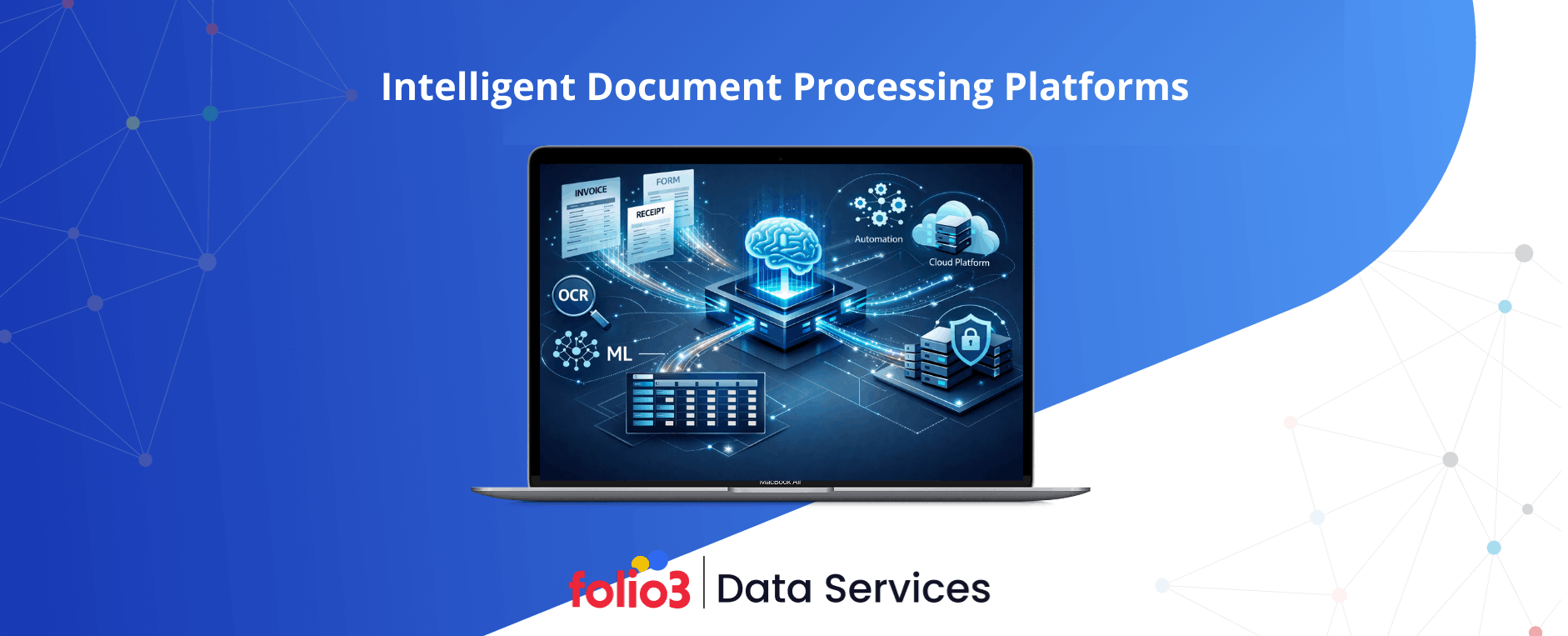

Intelligent Document Processing (IDP) applies AI, optical character recognition, and machine learning to extract, validate, and route data from unstructured documents—going far beyond OCR’s text detection to automate full business workflows. Demand is surging as enterprises modernize intake across invoices, claims, contracts, and forms; the US IDP market alone is projected to reach $2.3B by 2031 at a 20.9% CAGR, underscoring sustained adoption in mid-to-large enterprises.
To answer the core question—what’s the best IDP platform for processing unstructured documents in 2026?—the short answer is: it depends on your document mix, compliance posture, and ecosystem fit.
Enterprises exploring intelligent document processing should leverage insights from leading analysts to guide vendor selection. According to Gartner’s Market Guide for Intelligent Document Processing, organizations adopting AI-powered document automation can achieve faster processing and improved compliance, providing a benchmark for evaluating platform capabilities.
This guide compares top cloud APIs and enterprise suites to help data leaders select a future-proof platform that meets accuracy, scale, and governance requirements.
1. Folio3 Data Intelligent Document Processing Solutions
Folio3 Data designs and implements enterprise-grade IDP solutions that unify data extraction, validation, and downstream integration across regulated industries. Our teams bring certified expertise in secure, scalable architectures for manufacturing, financial services, retail, and healthcare, emphasizing measurable outcomes over pilots that never scale.
For enterprises evaluating IDP solutions, Forrester’s Total Economic Impact report highlights measurable ROI and efficiency gains from scalable AI-powered document automation, reinforcing the importance of human-in-the-loop validation for accuracy and compliance.
What sets our approach apart:
- Cloud-agnostic delivery and deep integration with Snowflake, Databricks, lakehouse architectures, and major ERP stacks—ensuring that data flows seamlessly from document to system of record.
- A consultative model that aligns use cases to the right AI engines (prebuilt models, custom models, or hybrid) and establishes human-in-the-loop controls to accelerate accuracy gains.
- End-to-end governance with audit trails, role-based access, and compliance alignment for HIPAA, PCI, SOX, and public-sector standards.
Client impact example: ESGTree automated ESG questionnaire completion and document ingestion using AI-powered data extraction across multiple client engagements, reducing compliance timelines from six months to near-real-time processing. The solution improved reporting accuracy and governance while cutting manual effort by over 60%, enabling faster audits, better stakeholder transparency, and continuous ESG compliance.
2. ABBYY Vantage
ABBYY Vantage offers low-code/no-code “document skills” covering 150+ document types, making it a strong choice for large organizations that need rapid deployment at global scale. Its strengths include multilingual handwriting, checkmarks, and signature detection, plus prebuilt classification models and robust human-in-the-loop review—valuable across finance, healthcare, and the public sector. According to the Everest Group IDP PEAK Matrix 2025, ABBYY Vantage is recognized for enterprise-grade governance, global deployment capabilities, and strong scalability, making it a preferred option for regulated industries.
Enterprise buyers appreciate governance features and compliance alignment common in highly regulated environments, with deployment options that meet strict data residency needs. For finance teams specifically, ABBYY’s structured extraction and validation capabilities also make it a strong option for AI invoice processing at scale. For a detailed overview of capabilities and enterprise fit, see this analysis of leading IDP suites from Unframe AI’s industry roundup (noted for its coverage of ABBYY Vantage).
3. Google Document AI
Google Document AI is a cloud-native IDP built on decades of OCR innovation, featuring strong handwriting recognition across 50 languages and transparent, tiered pay-per-page pricing (roughly $1.50–$10 per 1,000 pages depending on the processor). These characteristics make it ideal for organizations with variable volumes, short onboarding timelines, and a preference for API-first adoption. Out-of-the-box connectors streamline integration, though complex business rules typically require orchestration via cloud functions or BPM/RPA layers. For specifics on pricing tiers and technical differentiators, see XBP Global’s buyer’s guide to enterprise IDP platforms.
4. Microsoft Azure AI Document Intelligence
For Microsoft-centric organizations, Azure AI Document Intelligence combines prebuilt processors (invoices, receipts, IDs, contracts) with the ability to train custom models from as few as five samples—helpful when document volumes are high but labeled data is scarce. Pay-per-page pricing scales by model complexity, with enterprise-grade security and FedRAMP High certification favored in government, defense, and healthcare. Tight integration with Office 365, Power Platform, and Azure services accelerates adoption; expect a learning curve when optimizing custom models and building complex workflows.
5. UiPath IXP
UiPath IXP (Intelligent eXtraction Platform) brings document understanding into RPA-native workflows, enabling automation teams to embed IDP directly into end-to-end processes. Low-code tools empower citizen developers, while centralized orchestration, monitoring, and governance controls maintain enterprise standards.
With numerous prebuilt scenarios for finance, HR, and claims, UiPath is well-suited for organizations aiming to stitch document intake to downstream actions across bots, queues, and exception handling within the same stack.
6. Amazon Textract
Amazon Textract offers pay-as-you-go extraction tuned for the AWS ecosystem, integrating seamlessly with S3, Lambda, Step Functions, and Comprehend for post-processing. It’s particularly adept at extracting tables and key-value pairs from scanned documents at scale, featuring a free tier for early testing and straightforward per-page pricing. Market research from Coherent Market Insights highlights Textract’s strength in scalable, cloud-native document processing and AI-driven table extraction for financial and operational workflows.
For complex use cases like accounts payable or claims adjudication, expect to add validation logic and human review to achieve high precision. A practical overview of Textract’s strengths and AWS-native fit is available in Turian.ai’s comparison of leading IDP solutions.
7. Rossum
Rossum is a template-free, AI-first platform designed for unstructured, high-variance documents—especially invoices and AP artifacts. Its models learn layouts dynamically and improve through human-in-the-loop feedback, reducing the need for rigid templates and accelerating time-to-value in finance operations. According to Rossum’s Forrester Wave recognition, the platform’s AI-first, template-free approach sets it apart in automating AP and invoice-heavy processes. Rossum’s reporting and audit features support compliance requirements in shared services and BPO environments, with integrations that connect to ERPs and workflow tools. For a concise summary of Rossum’s template-free posture and AP adoption, see FlowWright’s review of top IDP products.
8. Kofax Tungsten Automation
Kofax (now Tungsten Automation) is a mature choice for enterprises needing multichannel capture, mobile intake, and sophisticated workflow design under strict governance. It scales effectively across distributed capture sites and integrates seamlessly with RPA and case management. Analysts at HTF Market Insights emphasize Kofax’s enterprise orchestration capabilities and compliance focus, making it a top choice for mailroom and claims-intensive workflows. Pricing is typically quote-based and contractually tied to committed page volumes, reflecting its enterprise focus. Organizations with complex mailroom or claims intake often favor Kofax for its orchestration depth and compliance controls.
9. OpenText Intelligent Document Processing
OpenText blends IDP with enterprise content management, creating a unified solution for extraction, records management, and compliant archiving—making it well-suited for finance, legal, life sciences, and the public sector. OpenText’s analyst coverage highlights its combined ECM + IDP capabilities, improving audit readiness and lifecycle governance. Features include detailed audit trails, granular access control, and connectors to core line-of-business systems. For document-centric environments with heavy regulatory obligations, the combination of ECM and IDP can simplify audit readiness and policy enforcement across the lifecycle.
10. Indico Data
Indico Data employs a hybrid AI approach rooted in transfer learning to handle unstructured and novel document types with minimal labeled data. This enables rapid deployment for insurance, compliance, and bespoke enterprise workflows, where documents don’t conform to standard templates. Academic research on hybrid OCR + LLM frameworks supports Indico’s transfer learning approach as an effective method for reducing labeling overhead while improving extraction accuracy. Business users can iteratively refine models via feedback loops, driving continuous performance improvement without extensive data science overhead.
How to Choose the Best Intelligent Document Processing Platform
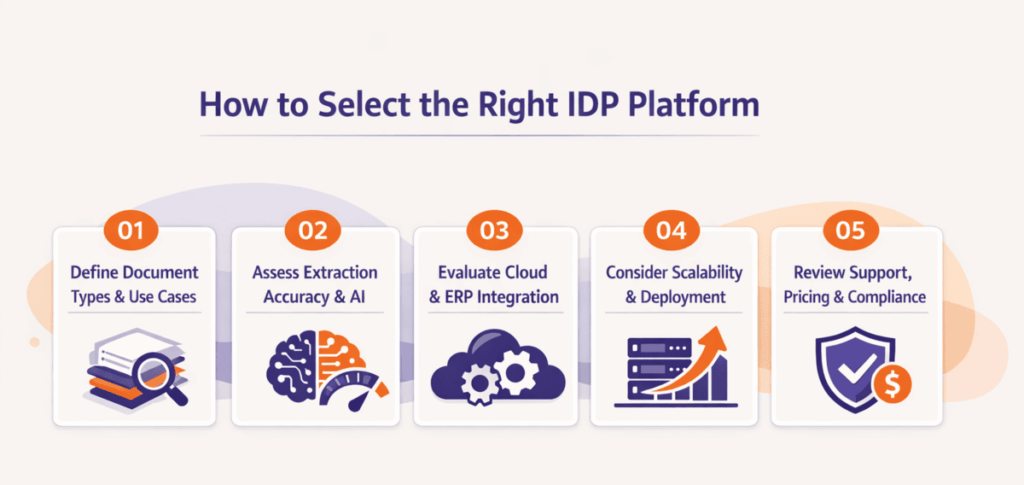
Use a structured evaluation to shortlist vendors by accuracy, ecosystem fit, compliance, and cost-of-scale. Start with your document reality, validate extraction on real samples, and plan a phased rollout with human-in-the-loop to close early accuracy gaps. For a deeper primer on data extraction strategy, see our guide to automated data extraction from Folio3 Data.
Comparison snapshot (indicative; verify with pilots):
| Platform | Best for | Accuracy/AI Notes | Compliance & Governance | Integration Fit | Cost Model |
| Folio3 IntelliExtract (AI Data Extraction) | Enterprises needing scalable document extraction | Proprietary AI + OCR with human-in-loop validation; 95%+ accuracy | AES-256 encryption, ISO 27001, HIPAA; audit trails | Email/API/folder upload; exports to CSV/JSON/XML; connectors to ERPs/CRM | Services + licensing (custom pricing) |
| ABBYY Vantage | Large enterprises, global scale | Strong handwriting/signature; 150+ skills | Enterprise-grade controls | Broad connectors; ECM/RPA | License/volume contracts |
| Google Document AI | Variable volumes, API-first onboarding | Handwriting in 50 languages; mature OCR | Cloud security; regional options | GCP-native; out-of-box connectors | Transparent pay-per-page |
| Microsoft Azure AI Doc Intel | Microsoft-centric, regulated industries | Prebuilt + custom from 5 samples | FedRAMP High; Azure governance | Azure/Power Platform/365 | Tiered pay-per-page |
| UiPath IXP | RPA-led automation programs | Low-code training; in-workflow learning | Centralized governance | Deep UiPath/RPA ecosystem | Platform licensing + usage |
| Amazon Textract | AWS-native scale, event-driven workloads | Tables & key-value extraction at scale | AWS security/compliance | S3, Lambda, Step Functions | Pay-as-you-go |
| Rossum | AP/invoice-heavy, high-variance docs | Template-free; human-in-the-loop improvement | Auditability, user roles | ERP/finance integrations | Subscription + usage |
| Kofax Tungsten Automation | Complex intake and orchestration | Advanced classification/workflows | Strong enterprise governance | RPA/case management | Quote-based, volume commitments |
| OpenText IDP | ECM-driven compliance environments | Extraction + records management | Deep audit trails, access control | LOB/ECM connectors | Enterprise licensing |
| Indico Data | Unstructured/novel document types | Transfer learning; rapid retraining | Enterprise controls | Flexible APIs; custom workflows | Subscription + usage |
Define Your Document Types and Use Cases
Inventory the documents you process (invoices, claims, receipts, contracts) and note variability (structured, semi-structured, unstructured). Platforms with pre-trained models for common forms typically deliver faster time-to-value, while highly variable documents may require template-free engines or custom models. Create a simple matrix mapping your document types to each platform’s prebuilt “skills” or processors.
Assess Extraction Accuracy and AI Capabilities
Prioritize precision and straight-through processing—the share of documents that flow from intake to system of record with no human correction. Validate vendor claims using your real samples, including handwriting and low-quality scans; Google Document AI’s handwriting support across 50 languages is a helpful benchmark for multilingual intake. Favor solutions with human-in-the-loop review to manage edge cases and accelerate model learning early in rollout.
Evaluate Integration with Cloud and ERP Systems
Document your current cloud platforms, data pipelines, RPA tools, and ERPs. Shortlist IDP that aligns with your ecosystem (AWS-native for Textract, Azure-native for Microsoft shops, GCP for Document AI) and verify the availability of out-of-the-box connectors or APIs for your systems of record. This reduces integration effort and speeds time-to-value.
Consider Scalability and Deployment Preferences
Choose cloud APIs for elastic, pay-as-you-go scaling or enterprise/on-prem packages when governance, isolation, or large volume discounts are paramount. Transparent per-page pricing from vendors like Google and AWS simplifies forecasting, while on-prem suites such as ABBYY or Kofax often start with six-figure contracts when deployed at scale. Ensure robust user management, auditability, and regional compliance if operating across geographies.
Review Vendor Support, Pricing Models, and Compliance Features
Evaluate vendor reputation, SLAs, training resources, and roadmap transparency. Understand pricing—metered per-page, subscription plus usage, or quote-based volume contracts—and align to your volume and seasonality. Confirm compliance features (e.g., FedRAMP, audit logging, role-based access) to satisfy internal and regulatory requirements.
Frequently Asked Questions
What Is Intelligent Document Processing and How Does It Differ from OCR?
Intelligent Document Processing combines OCR, machine learning, and NLP to classify and extract structured data from diverse documents, while OCR alone converts images into text without context or validation.
Which Industries Benefit Most from Intelligent Document Processing Platforms?
Finance, healthcare, insurance, manufacturing, and the public sector leverage IDP to automate invoices, claims, contracts, and forms with higher accuracy and enhanced compliance.
How Accurate Are Intelligent Document Processing Solutions?
Leading platforms often exceed 90% accuracy on common documents, with rates improving as models learn from validated feedback on edge cases.
What Features Should I Prioritize for Processing Unstructured Documents?
Look for template-free extraction, strong table and handwriting recognition, and human-in-the-loop review to effectively handle exceptions and continuously boost accuracy.
How Does Human-in-the-Loop Improve Document Processing Accuracy?
Human review provides targeted corrections that retrain models on real-world edge cases, rapidly enhancing precision and straight-through processing over time.
Conclusion
Intelligent Document Processing is no longer a “nice to have” capability; it is a business-critical system for modern enterprises that want to scale automation, improve accuracy, and reduce manual workload across document-heavy operations. When document intake, validation, and routing are automated, organizations achieve faster processing, stronger compliance, and better visibility into their operations. The best IDP platform depends on your document types, volume, ecosystem, and governance requirements, but the right solution always starts with clear use cases and measurable outcomes.
Folio3 Data Services helps enterprises build and deploy IDP solutions that are accurate, scalable, and compliant. Our teams design end-to-end implementations that integrate AI extraction, human-in-the-loop validation, and downstream system automation across Snowflake, Databricks, lakehouses, and major ERP systems. Whether you need a fast pilot or a global-scale rollout, we provide the expertise and architecture to turn unstructured documents into reliable, actionable data that drives measurable business value.