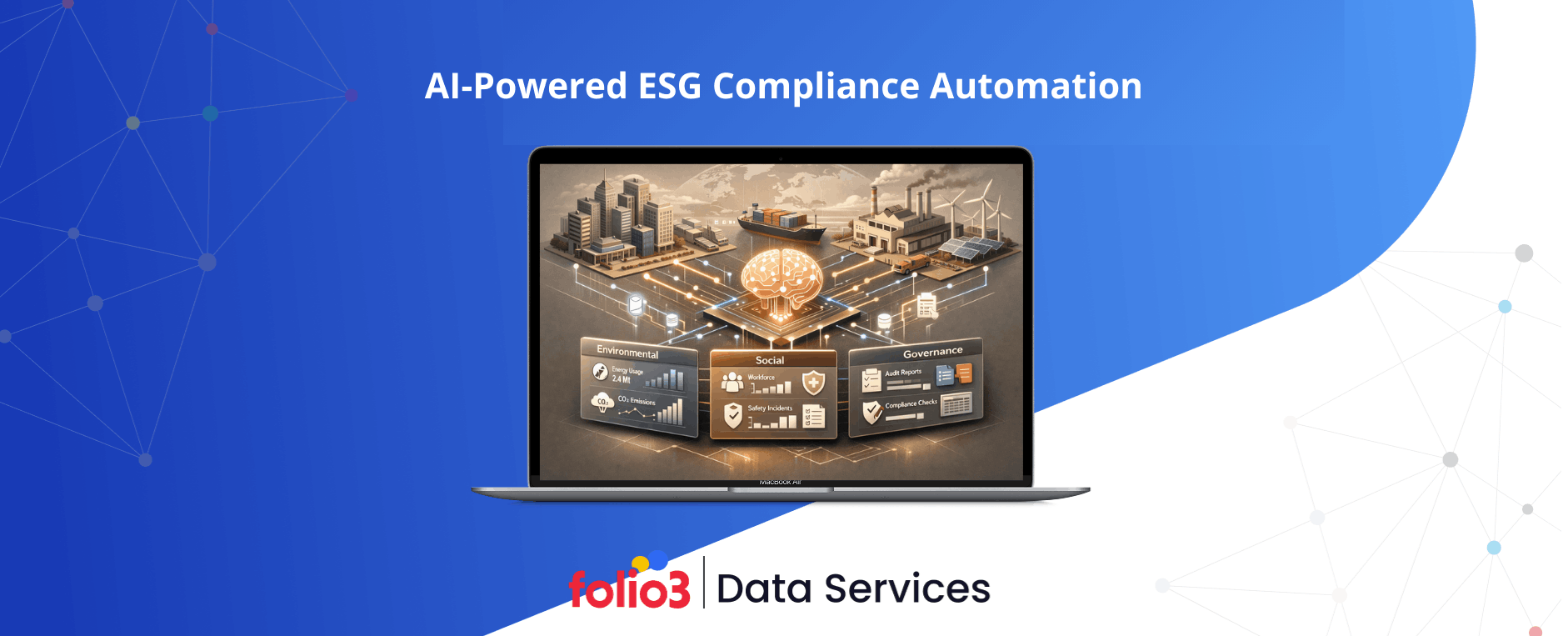

Enterprises are under mounting pressure to produce fast, accurate, and audit-ready ESG disclosures across multiple frameworks—without ballooning the cost of compliance. This guide explains how to implement an AI solution for automating ESG compliance questionnaires, from data extraction to disclosure, with the governance and auditability regulators expect. Designed for Chief Data Officers, VPs of Analytics, and compliance leaders, it blends pragmatic steps with technical depth so you can reduce cycle times, harden controls, and modernize ESG data operations. Folio3 Data brings certified expertise in AI-driven data extraction, cloud-scale integration, and compliance workflows—enabling mid-to-large enterprises to turn ESG into a continuously reliable, ROI-positive capability supported by real-world deployments and measurable outcomes.
Understanding ESG Compliance Challenges for Enterprises
ESG compliance is the process of systematically collecting, managing, and reporting data on environmental, social, and governance factors to meet legal, regulatory, and stakeholder requirements. At enterprise scale, the challenge is structural. Data lives in ERPs, HRIS, procurement and supplier portals, emissions trackers, and cloud logs, often requiring AI-powered data extraction to surface relevant metrics from unstructured and semi-structured sources. Standards evolve, overlap, and diverge across CSRD, GRI, SASB/ISSB, ESRS, and SEC. Manual workflows create cost, risk, and long audit preparation cycles—and disclosures can drift without continuous verification.
The pressure is real: more than 60% of companies report increasing demands for sustainability data, with regulatory fragmentation and data burdens cited as core pain points, according to AI & ESG: Empowering ESG with GenAI. Enterprises need automation that can unify data, map to multiple frameworks, and produce defensible, consistent outputs—on demand.
The Role of AI in Automating ESG Compliance Questionnaires
An ESG compliance questionnaire is a structured set of queries designed to collect standardized sustainability and governance data from internal and external sources for audit and disclosure purposes. AI accelerates this process by acting as a digital co-pilot across collection, validation, and drafting:
- Auto-collecting evidence by integrating with ERP, HR, finance, supplier portals, and cloud platforms; leading tools highlight connectors and auto-fetching of controls and logs, as profiled in best AI tools for compliance.
- Automatically mapping controls and metrics to frameworks (e.g., ISO 27001 for governance controls; GRI, SASB/ISSB, ESRS, and CSRD for ESG metrics), with AI-assisted analysis that learns your organization’s taxonomy over time.
- Generating auditable, draft responses and narratives using domain-tuned models that cite source evidence and flag uncertainties for human review.
Analyst-curated ESG software lists show platforms like AuditBoard, Plan A, and Folio3 Data’s solutions using AI to centralize data collection, automate questionnaires, and support audit-ready documentation—see ESG software and tools for market coverage.
Key Features of AI-Powered ESG Compliance Automation Solutions
When evaluating ESG automation tools, expect capabilities that eliminate manual steps while strengthening audit defensibility.
| Capability | What it does | Why it matters |
| Automated evidence fetching | Auto-pulls HR, ERP, emissions, and cloud logs (e.g., Workday, SAP, AWS, Splunk) via APIs | Reduces manual collection; ensures data freshness and completeness |
| Centralized compliance workspace | Unifies multi-framework alignment (CSRD, GRI, SASB/ISSB, ESRS, SEC) | Keeps disclosures consistent across jurisdictions and reporting cycles |
| AI-driven metrics, gaps, and risk | Explains metrics, performs gap assessments, and surfaces risks | Focuses teams on remediation; reduces interpretation errors |
| Immutable audit trails | Records data lineage, model prompts/outputs, and evidence snapshots | Strengthens assurance and external audit readiness |
| Human-in-the-loop controls | Routes flagged items for expert review and approval | Maintains accountability and regulatory defensibility |
| Pre-built templates | Provides CSRD, GRI, SASB/ISSB, ESRS, SEC templates with control mappings | Accelerates onboarding and ensures coverage of required fields |
A gap assessment is the process where AI compares your current data and processes to required standards, surfacing discrepancies and recommended fixes. Advanced ESG tools can run first-pass gap analyses across large document sets and link claims to page-level evidence for swift audit verification, a capability increasingly aligned with practices seen in data analytics in finance and documented in ESG due diligence.
Step-by-Step Implementation of AI for ESG Compliance Automation
A practical rollout follows a staged workflow that embeds governance and auditability into each step:
- Assess data and map to frameworks
- Integrate systems for automated data ingestion
- Validate, normalize, and analyze with AI
- Automate narrative generation and template completion
- Operationalize continuous monitoring
- Establish governance and audit processes
1. Assessing Data Sources and Mapping to ESG Frameworks
Start with a comprehensive inventory of ESG-relevant data: energy and utilities, procurement and supplier data, finance and risk, HR and DEI, operations logs, and facilities telemetry. Prioritize connected systems and material Scope 3 categories. Map existing metrics to disclosure requirements for CSRD, SEC, GRI, SASB/ISSB, and ESRS—AI-driven inventories can speed this by detecting metric synonyms and unit variants noted in leading software reviews.
Sample mapping starter:
| Source category | Example systems | Typical metrics | Target frameworks |
| Energy & facilities | Utility APIs, BMS/IoT | Electricity use, renewables share, water intensity | CSRD, GRI 302/303, ESRS E1 |
| Procurement & suppliers | SAP Ariba, Coupa, supplier portals | Supplier emissions, certifications, labor standards | CSRD, GRI 308/414, SEC climate |
| Finance & risk | ERP/GL, TCFD-aligned risk models | Carbon cost, climate risk scenarios | CSRD, SEC climate, SASB/ISSB |
| HR & DEI | Workday, SuccessFactors | Headcount, pay equity, safety incidents | GRI 401/403/405, ESRS S1 |
| Cloud & IT | AWS/Azure/GCP logs, Splunk | Data center energy, security controls | GRI 302, ISO 27001 mappings |
2. Integrating Systems for Automated Data Ingestion
Connect ERPs, HRIS, emissions trackers, supplier portals, cloud storage, and observability tools using secure connectors and APIs. Automated data ingestion is the seamless extraction and loading of data from disparate sources into a unified ESG system. Prioritize auto-fetching of evidence and ensure every capture is recorded with immutable, timestamped audit records—capabilities highlighted among best AI tools for compliance.
3. Validating, Normalizing, and Analyzing ESG Data with AI
Use domain-tuned AI to normalize units and formats (e.g., kWh to MWh, kg CO2e to tCO2e), flag anomalies and missing values, and estimate gaps where permitted. Enable first-pass gap analyses at the metric and control level, with human oversight for any flagged cases. Provide transparent lineage from source to disclosure to meet assurance requirements—see the AI and ESG guide for practices that improve credibility and defensibility.
4. Automating Narrative Generation and Template Completion
Generative AI can transform validated metrics into draft disclosures, control mappings, and management narratives aligned to CSRD, GRI, SASB/ISSB, ESRS, and SEC templates. Require final human sign-off, with every edit versioned and linked to evidence. For a deep dive on automating narrative quality and consistency, review Generative AI for ESG.
5. Operationalizing Continuous Compliance Monitoring
Move from one-and-done reporting to continuous compliance. Use dashboards, scheduled checks, and real-time alerts for data drift, missing values, and regulatory changes. Automate supplier follow-ups and questionnaire cycles as Scope 3 demands expand, and monitor multi-framework mappings to prevent divergence across jurisdictions.
6. Establishing Governance and Audit Processes
Codify SLAs for human review, model versioning and retraining cadences, and strict evidence retention. Adopt immutable audit trails and role-based approvals—capabilities commonly emphasized by AI compliance tools. Data lineage is a clear record of every source, transformation, and validation step in your ESG process; it is foundational for demonstrating auditability to internal and external assurance teams.
Folio3 designs and implements end-to-end ESG compliance automation—covering data ingestion, AI validation, narrative generation, and audit-ready reporting.
Benefits of AI-Driven ESG Compliance Automation for Enterprises
Leaders adopt AI not only for speed but also for resilience and precision:
- Up to 75% reduction in compliance review cycles and audit preparation time, as reported in the AI in sustainability report.
- Reduction in manual effort by 30–95% and reporting cycles accelerated by 60–85%, per industry analyses such as AI & ESG: Empowering ESG with GenAI.
- Higher accuracy and transparency via evidence-linked outputs and consistent multi-framework alignment.
- Strategic upside: improved supply chain traceability, faster audit resolution, and readiness for ESG-linked revenue opportunities.
Folio3 Data clients often pair these gains with modernization of data pipelines and stronger change management—ensuring benefits compound over time.
Technical Approaches Behind Effective AI ESG Automation
Advanced Document Intelligence and Data Extraction
Modern ESG automation relies on advanced OCR, NLP, and layout-aware parsing to extract structured data from PDFs, spreadsheets, emails, and scanned reports—linking each disclosure back to page-level evidence for traceability, as demonstrated in ESG due diligence use cases. For a deeper look at the tooling landscape, see our overview of best IDP platforms for unstructured documents.
Proprietary AI Models and Regulatory Matching
Proprietary ESG AI models are trained with sustainability taxonomies, regulatory logic, and sector benchmarks to minimize hallucinations and mismatches. For compliance-grade outputs, enforce human-in-the-loop review, continuous retraining, and explainability—practices outlined in the AI and ESG guide. Generic LLMs can accelerate drafting but should be constrained by retrieval-augmented generation, policy guards, and domain-tuned scoring to avoid compliance risk.
Integration Architectures and Collaboration Tools
Adopt modular, API-first architectures that bridge ERP, HR, cloud, and supplier platforms into a unified ESG data fabric—an approach echoed in ESG AI for business transformation. Layer in role-based permissions, no-code/low-code workspaces for compliance teams, and collaborative review flows so legal, finance, sustainability, and audit can work from a single source of truth.
Navigating Regulatory Frameworks with AI Support
Compliance with CSRD, GRI, SEC, and Other Standards
Use pre-built templates, automated control mapping, and real-time regulation monitoring to keep disclosures aligned with CSRD, GRI, SASB/ISSB, ESRS, and SEC climate rules. Differences to note:
| Framework | Core scope/focus | Typical disclosures | Data rigor and assurance |
| CSRD/ESRS | Broad, double materiality, EU-centric | E1–E5, S1–S4, G1 metrics, targets, policies | High rigor; assurance required and expanding |
| GRI | Global, stakeholder-oriented | Topic standards (e.g., GRI 302, 403) | Moderate-to-high; emphasis on completeness |
| SASB/ISSB | Industry-specific, investor-focused | Financially material, sector KPIs | High relevance to capital markets |
| SEC climate | US investor protection | GHG, climate risks, governance, scenarios | High rigor; liability implications |
AI helps maintain consistent crosswalks across these frameworks while preserving the nuance each requires.
Managing Supplier and Scope 3 Reporting
Scope 3 emissions are indirect emissions across your value chain—from upstream suppliers to downstream logistics and product use—that are often the hardest to measure and verify. AI-powered supplier portals and automated workflows streamline data requests, validation, and consolidation. Pilot with priority suppliers, standardize templates, and pre-define audit tests before scaling across tiers. For related data engineering patterns, explore supply chain data integration.
Best Practices for Maximizing ROI and Reliability in ESG Automation
- Prefer purpose-built ESG AI over generic LLMs; constrain generation with retrieval and domain ontologies.
- Embed human oversight for flagged metrics, sensitive narratives, and final sign-offs.
- Maintain strong data lineage with immutable logs and evidence snapshots.
- Map once, publish many: align to multiple frameworks from a centralized workspace.
- Pilot supplier integrations and assurance workflows before global rollout.
- Refresh models and connectors regularly; measure cycle-time, effort, and audit-findings KPIs.
Organizations using AI-assisted integrations have cut audit preparation from months to days and improved defensibility in external assurance reviews, as highlighted in the AI in sustainability report. Folio3 Data pairs this with consultative change enablement, cloud-native scaling, and ongoing model stewardship to sustain results.
Future Trends in AI and ESG Compliance Automation
- AI plus blockchain will elevate supply chain provenance and ethical sourcing by anchoring vendor attestations and transactions to tamper-evident ledgers, as explored in blockchain and AI for provenance.
- Generative AI will deliver dynamic, multi-stakeholder narratives tailored to regulators, investors, and customers.
- Predictive compliance will forecast disclosure risks, data gaps, and supplier non-responsiveness—triggering preemptive actions.
- Explainable AI, adaptive models, and IoT integration will enable real-time sustainability insights with clear, auditable rationales.
To explore how these trends can accelerate your roadmap, review Folio3 Data’s case studies and schedule a working session with our team.
Frequently Asked Questions
What are the main challenges AI addresses in ESG compliance?
AI reduces regulatory complexity and manual data collection by automating validation, mapping to multiple frameworks, and generating audit-ready responses with real-time insights.
How does AI reduce manual effort in ESG reporting?
By auto-collecting, normalizing, and validating ESG data—and drafting disclosures—AI can cut manual effort by up to 95% and accelerate reporting cycles.
What are the typical benefits enterprises gain from AI-powered ESG automation?
Enterprises gain faster audit preparation, lower compliance costs, more accurate disclosures, and improved management of supplier and Scope 3 reporting.
How should enterprises approach implementing AI for ESG compliance?
Follow a phased plan: assess and map data sources, integrate systems, validate and normalize with AI, automate templates and narratives, monitor continuously, and uphold strong governance.
How does AI ensure auditability and governance in ESG processes?
Auditability is achieved through data lineage tracking, human-in-the-loop reviews, version control, explainable outputs, and strict evidence retention and access controls.
Conclusion
AI-powered ESG compliance automation enables enterprises to move from fragmented, manual reporting to a unified, audit-ready, and continuously reliable process. By automating data ingestion, validation, framework mapping, and disclosure drafting, organizations can reduce compliance cycles, lower risk, and maintain consistency across CSRD, GRI, SASB/ISSB, ESRS, and SEC requirements. The real value lies not only in speed, but in stronger governance, traceability, and confidence during audits.
Folio3 Data Services helps enterprises design and implement ESG automation solutions that are scalable, defensible, and built for real regulatory scrutiny. With certified expertise in AI-driven data extraction, cloud integration, and compliance workflows, we enable organizations to transform ESG from a periodic reporting burden into a resilient, ROI-positive capability that supports long-term sustainability and business growth.