
Every day, organizations generate over 2.5 quintillion bytes of data, yet most struggle to turn this information into meaningful insights. Traditional methods of organizing, cleaning, and protecting data can’t keep up with the speed and volume of modern business operations. This challenge has created an urgent need for smarter approaches that can adapt and learn.
AI data management uses machine learning and automation to handle the complex tasks of organizing, securing, and analyzing information at scale. Instead of relying on manual rules and human intervention, these systems learn patterns, detect anomalies, and make intelligent decisions about how data should be processed and stored. From automated quality checks to intelligent classification, AI transforms data operations from a bottleneck into a competitive advantage.
According to Gartner, over 80% of enterprises will use AI-enabled applications by 2026, making effective AI data management not just beneficial but essential for survival. This guide explores how organizations can leverage intelligent systems to manage their data better, faster, and more cost-effectively.
What Is AI Data Management?
AI data management applies artificial intelligence to automate and optimize how organizations collect, store, process, and govern their data assets throughout the entire lifecycle.
AI data management combines machine learning algorithms with traditional data platforms to create self-improving systems that automatically classify information, detect quality issues, and recommend optimization strategies without constant human oversight.
The core components include intelligent automation, predictive modeling, natural language processing, and continuous learning capabilities that adapt to changing data patterns. Machine learning algorithms analyze historical patterns to predict future data behavior and quality issues, learning from past corrections and decisions to improve accuracy over time.
Unlike traditional automation that handles repetitive tasks through predefined rules, AI-powered intelligence adapts and learns from experience to adjust behavior based on new patterns.
Modern data environments constantly evolve with exponential growth, stricter compliance requirements, and increasing demands for real-time insights from countless sources in different formats. AI data management addresses these challenges by operating across the entire data stack from ingestion to analytics, enhancing data lakes with smart cataloging of AI-ready data, improving warehouses with predictive optimization, and strengthening pipelines with automatic error handling that makes current systems work better and scale more efficiently.
Why AI Data Management Matters
The shift to intelligent data management directly impacts business outcomes, operational efficiency, and competitive positioning in data-driven markets.
Business Impact Of Data Quality
Poor data quality costs organizations an average of $12.9 million annually, according to Gartner research. AI data management reduces these losses by catching errors before they propagate through systems. Better quality leads to more accurate forecasts, improved customer experiences, and fewer costly mistakes in strategic decisions.
Speed And Scale Requirements Today
Modern businesses need instant access to insights from petabytes of information. Manual data preparation takes weeks, but AI-powered systems process the same workloads in hours. This speed advantage lets companies respond to market changes faster, launch products quicker, and serve customers better than competitors stuck with legacy approaches.
Compliance And Governance Pressures
Regulatory frameworks demand detailed tracking of data lineage, access controls, and usage patterns. AI systems automatically document these elements, reducing compliance costs and risks. They identify sensitive information across complex environments, apply appropriate protections, and generate audit trails without manual intervention or extensive rule configuration.
The Cost Of Manual Data Work
Data teams spend up to 80% of their time on preparation and cleaning tasks. This manual work burns budget and delays insights. AI automation frees skilled professionals to focus on analysis and strategy instead of repetitive data manipulation, improving both morale and business outcomes.
Competitive Advantage Through Data Intelligence
Organizations that implement AI data management make decisions faster, operate more efficiently, and innovate more rapidly. They spot trends before competitors, personalize customer experiences at scale, and optimize operations continuously.
These capabilities are particularly impactful in AI customer analytics implementations, where understanding behavior and preferences in real time drives stronger engagement and loyalty. The intelligence gap widens over time as AI systems learn and improve while manual processes stagnate.
Traditional vs AI-Powered Data Management: Key Differences
| Aspect | Traditional Approach | AI-Powered Approach |
| Data Quality Checks | Manual rules and scheduled validation | Continuous automated monitoring with anomaly detection |
| Classification | Pre-defined taxonomies requiring manual tagging | Automatic classification using machine learning models |
| Error Detection | Reactive, finds issues after problems occur | Predictive, identifies potential issues before impact |
| Scalability | Linear, requires proportional resource increases | Exponential, handles growth with minimal added resources |
| Adaptation | Static rules need manual updates | Self-learning systems adapt to new patterns |
| Processing Speed | Hours to days for complex operations | Minutes to hours with parallel AI processing |
| Human Involvement | Constant oversight and intervention required | Exception-based, humans handle only edge cases |
| Cost Structure | High ongoing operational expenses | Upfront investment with decreasing operational costs |
Types Of AI Data Management Solutions
Organizations choose from several deployment models based on their security needs, existing infrastructure, budget constraints, and technical capabilities.
Cloud-Based Platforms
Cloud platforms offer rapid deployment without hardware investments. They provide automatic scaling, built-in redundancy, and continuous feature updates. Major providers like AWS, Azure, and Google Cloud integrate AI capabilities directly into their data services, reducing complexity for organizations already using these environments.
On-Premises Solutions
On-premises deployments give organizations complete control over their data and infrastructure. This model suits highly regulated industries with strict data residency requirements. While requiring more initial investment and ongoing maintenance, on-premises solutions offer maximum customization and security control for sensitive workloads.
Hybrid Solutions
Hybrid architectures combine cloud flexibility with on-premises control. Organizations keep sensitive data local while leveraging cloud resources for processing and analytics. This approach balances security requirements with operational efficiency, allowing gradual migration strategies and risk distribution across multiple environments.
Open-Source vs Enterprise
| Feature | Open-Source Solutions | Enterprise Platforms |
| Cost | Free licensing, internal support costs | Licensing fees with vendor support |
| Customization | Full code access and modification rights | Limited to vendor-provided configurations |
| Support | Community forums and self-service | Dedicated support teams and SLAs |
| Features | Core capabilities, extensions via plugins | Comprehensive out-of-box functionality |
| Security Updates | Community-driven patch schedules | Guaranteed security patches and compliance |
| Integration | Requires custom development effort | Pre-built connectors for major systems |
| Scalability | Depends on implementation skills | Engineered for enterprise scale |
| Innovation | Community experimentation and contributions | Research-backed feature development |
AI-Powered Tools For Smarter Data Management
Leading platforms combine artificial intelligence with proven data management capabilities to deliver enterprise-grade solutions.
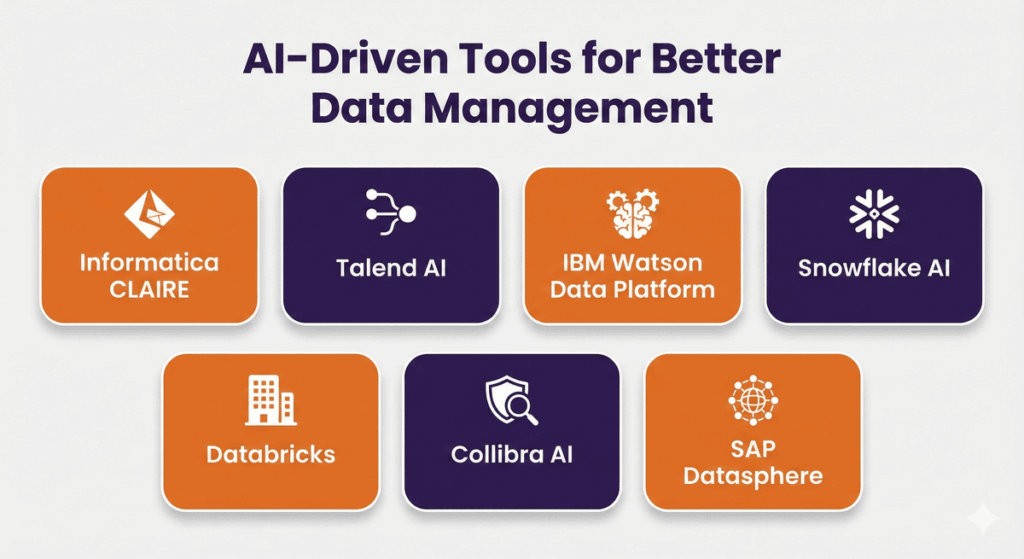
Informatica CLAIRE
Informatica CLAIRE uses AI to automate data integration, quality management, and governance workflows. The platform applies machine learning to recommend data mappings, identify quality issues, and suggest remediation actions.
CLAIRE also supports ai-powered data extraction to efficiently gather information from diverse sources, learning from user corrections to improve accuracy over time across complex multi-cloud environments.
Talend AI
Talend integrates machine learning into data preparation and integration pipelines. Its smart recommendations help users clean data faster by suggesting transformations based on patterns. The platform automates schema mapping and provides intelligent data quality scoring that adapts to changing business rules.
IBM Watson Data Platform
IBM Watson combines AI-powered data cataloging with advanced analytics capabilities. The platform uses natural language processing to make data discoverable through conversational queries. Watson automatically profiles data assets, suggests relationships, and applies governance policies based on content understanding.
Snowflake AI
Snowflake embeds machine learning directly into its cloud data warehouse. Users can train and deploy models without moving data between systems. The platform handles automatic optimization, scaling, and feature engineering while maintaining security controls and governance frameworks.
Databricks
Databricks provides unified analytics combining data engineering, machine learning, and business intelligence. The platform automates cluster management, optimizes query performance, and enables collaborative AI development. Its lakehouse architecture supports both structured and unstructured data with consistent governance.
Collibra AI
Collibra focuses on AI-driven data governance and cataloging. The platform automatically discovers, classifies, and tags data assets across the enterprise. Machine learning powers policy recommendations, access controls, and compliance monitoring while reducing manual governance overhead.
SAP Datasphere
SAP Datasphere integrates business context with technical metadata using AI. The platform connects data across SAP and non-SAP systems while applying intelligent quality checks. Built-in machine learning models help predict data quality issues and recommend proactive remediation strategies.
Essential Features Of AI Data Management
Modern AI data management platforms must deliver specific capabilities that address real business challenges and technical requirements.
AI-Powered Data Quality
Intelligent quality systems continuously monitor data for accuracy, completeness, and consistency. Machine learning models detect anomalies that rule-based systems miss, adapting to seasonal patterns and business cycles. These features automatically suggest corrections and learn from user feedback to improve detection accuracy over time.
Automated Data Classification
Classification engines use natural language processing and pattern recognition to categorize data without manual tagging. They identify sensitive information like personal identifiers, financial data, and proprietary content across structured and unstructured sources. This automation ensures consistent policy application and reduces compliance risks.
Predictive Analytics Support
Platforms must prepare data specifically for machine learning workflows. This includes automated feature engineering, data sampling, and model training pipelines.
Integration with popular ML frameworks lets data scientists access clean, prepared datasets without involving data engineering teams for every experiment. Some platforms also extend capabilities to financial operations, supporting tasks like AI invoice processing to automatically extract, validate, and categorize billing information.
Intelligent Governance & Compliance
AI-driven governance automates policy enforcement, access controls, and audit trail generation. Systems learn organizational data usage patterns to recommend appropriate security levels. Automated compliance checking against regulations like GDPR, HIPAA, and CCPA reduces manual audit preparation and identifies violations before they become problems.
Cloud & On-Premise Integration
Hybrid deployment support lets organizations leverage both cloud scalability and on-premises security. Platforms must synchronize metadata, policies, and quality rules across environments. This flexibility supports gradual cloud migration strategies while maintaining consistent data management practices regardless of where data resides.
How AI Enhances Data Quality and Accuracy
Artificial intelligence brings precision and consistency to data quality management that manual processes cannot match at scale. Combining data engineering and AI ensures that both the pipelines and the models work together to maintain high-quality datasets.
Automated Error Detection
Machine learning algorithms identify data anomalies by learning normal patterns across datasets. Unlike static rules that generate false positives, AI distinguishes genuine errors from acceptable variations. These systems catch formatting inconsistencies, logical conflicts, and statistical outliers in real-time as data flows through pipelines.
AI Data Cleansing
Intelligent cleansing goes beyond simple fixes to understand context and intent. Natural language processing corrects address formatting, standardizes names, and resolves abbreviations based on surrounding information. The technology handles missing values through intelligent imputation using related records rather than simple averages or deletions.
Intelligent Deduplication
AI-powered deduplication matches records even when information differs across sources. Fuzzy matching algorithms account for typos, different naming conventions, and partial information to identify true duplicates. The system learns from user decisions about matches to improve accuracy and reduce false positives over time.
Predictive Quality Monitoring
Predictive models forecast quality degradation before it impacts business operations. By analyzing historical patterns, AI identifies upstream issues that will cause downstream problems. This foresight enables proactive fixes rather than reactive cleanup, maintaining consistent data quality even as source systems change.
AI’s Role in the Data Management Lifecycle
Artificial intelligence transforms every phase of data handling from initial discovery through final consumption and archival.
Intelligent Data Discovery & Classification
AI crawls data repositories to automatically catalog available information assets. Natural language processing extracts business context from column names, content, and metadata. The technology identifies relationships between datasets and suggests potential use cases based on similar past projects.
AI-Driven Data Preparation & Cleansing
Preparation workflows use machine learning to recommend transformations based on target requirements. The system identifies data types, suggests standardization approaches, and handles complex cleansing tasks.
Automated profiling highlights quality issues and estimates effort required for different preparation strategies. For many organizations, this also includes automated data extraction from structured and unstructured sources, reducing manual input and accelerating analytics readiness.
Enhanced Data Integration & Transformation
Integration engines use AI to map fields between disparate systems by understanding semantic meaning rather than just name matching. The technology adapts transformation logic as source schemas evolve, reducing maintenance overhead. Intelligent error handling routes problematic records for review while processing clean data without delays. Partnering with a skilled data engineering company can help organizations implement these AI-driven integrations efficiently and at scale.
Continuous Learning For Data Quality
Quality systems improve through feedback loops that capture user corrections and decisions. Machine learning models update their understanding of acceptable patterns and business rules. This continuous learning means accuracy improves over time without manual rule updates or configuration changes.
Smart Data Storage & Warehousing
AI optimizes how data is stored and indexed based on access patterns and query performance. Automated partitioning and clustering improve query speed while reducing storage costs. The technology predicts which data will be accessed together and organizes storage accordingly.
Advanced Analytics & Business Insights
AI layers on top of clean data to enable sophisticated analytics that drive business value. Predictive models forecast trends, classification algorithms segment customers, and recommendation engines personalize experiences. These capabilities support custom data analytics solutions, turning historical records into forward-looking competitive advantages.
AI Data Management Architecture Diagram
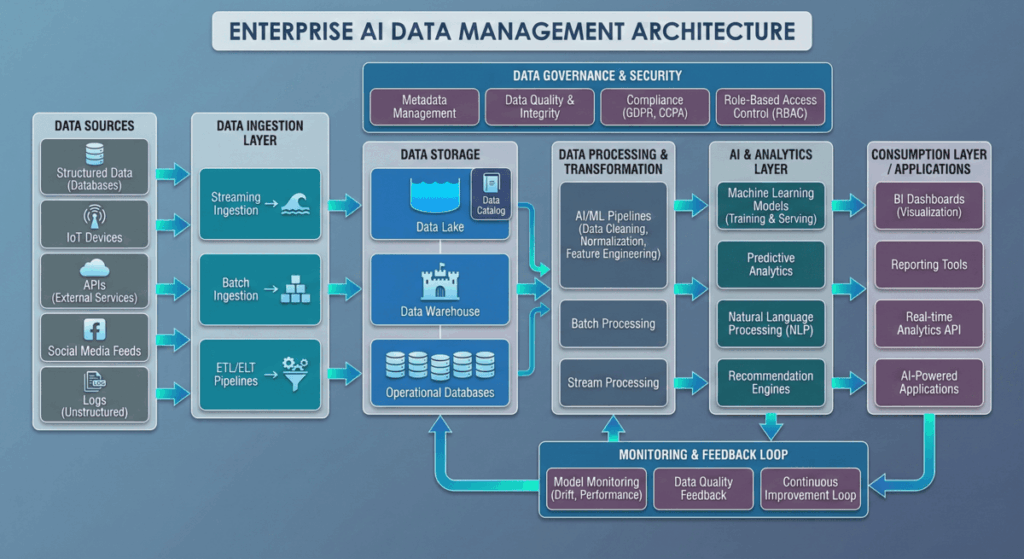
Modern AI data management architectures integrate intelligent capabilities across multiple layers to create self-optimizing data ecosystems.
A comprehensive AI data management architecture consists of several interconnected components. At the foundation, data sources feed information into intelligent ingestion layers that apply initial quality checks and classification. The processing layer uses machine learning models to cleanse, transform, and enrich data according to learned patterns.
A governance layer monitors all activities, enforcing policies and maintaining audit trails through automated rules. Storage systems optimize data organization based on predicted access patterns, while analytics layers apply advanced AI models to extract business insights. The entire architecture includes feedback loops where user interactions and outcomes train the AI components to improve performance continuously.
Advantages and ROI Of AI Data Management
Implementing intelligent data management delivers measurable returns across multiple business dimensions beyond simple cost savings.
Improved Data Accuracy
AI reduces error rates by up to 90% compared to manual processes. Higher accuracy means better business decisions, fewer customer complaints, and reduced rework. Organizations report significant improvements in forecast precision, inventory optimization, and customer targeting when operating on cleaner data.
Smarter Decision-Making
Real-time access to accurate insights lets executives make informed choices faster. AI-powered dashboards surface trends and anomalies automatically, eliminating analysis delays. Teams spend less time validating information and more time acting on opportunities before competitors react.
Cost and Efficiency Gains
Automation reduces data team workloads by 60-80%, according to industry studies. Organizations redeploy skilled professionals to strategic initiatives rather than repetitive tasks. Infrastructure costs decrease through intelligent resource allocation and automated optimization that maximizes existing investments.
Scalable Data Handling
AI systems process exponentially more data without proportional cost increases. Organizations handle growing volumes from IoT devices, customer interactions, and operational systems without constant infrastructure expansion. This scalability supports business growth without creating data bottlenecks.
Compliance and Security
Automated governance reduces compliance costs by 40-50% while improving audit readiness. AI systems maintain detailed lineage, apply consistent policies, and detect violations instantly. Organizations avoid regulatory fines and reputational damage through proactive rather than reactive compliance management.
Measurable Business ROI
Organizations typically achieve ROI within 12-18 months of implementing AI data management. Benefits include faster time-to-market for new products, improved customer retention through personalization, and reduced operational costs. The returns compound over time as AI systems learn and optimize continuously.
Common Obstacles In AI Data Management
Organizations face predictable challenges when implementing intelligent data management that require thoughtful planning and mitigation strategies.
Data Privacy & Security
AI systems need access to sensitive information for training and operation, creating security concerns. Organizations must balance AI capabilities with privacy regulations and customer trust. Implementing proper access controls, encryption, and anonymization techniques while maintaining AI effectiveness requires careful architecture and ongoing monitoring.
Implementation Complexity
Deploying AI data management across existing technology stacks involves significant integration work. Legacy systems may lack APIs or metadata standards necessary for AI tools. Organizations struggle with change management as teams adapt to new workflows and automated processes that alter traditional roles.
Legacy System Integration
Older systems weren’t designed for AI integration, creating technical gaps. Extracting metadata, establishing data lineage, and maintaining real-time synchronization with legacy platforms requires custom development. Organizations must decide between modernizing legacy infrastructure or building complex middleware layers.
AI Bias & Governance
Machine learning models can perpetuate biases present in training data, leading to unfair outcomes. Organizations need frameworks to detect, measure, and mitigate algorithmic bias. Establishing accountability for AI decisions and maintaining explainability while leveraging complex models creates governance challenges that traditional frameworks don’t address.
Best Practices For Implementing AI Data Management
Successful implementations follow proven patterns that maximize value while minimizing risks and disruption.
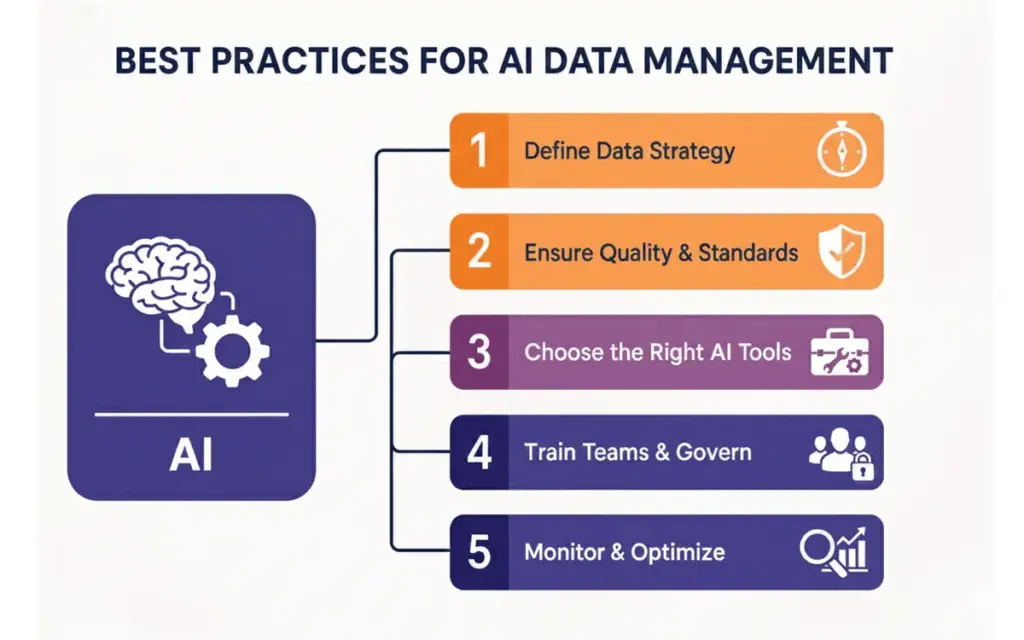
Define Clear Data Strategy
Establish specific business objectives before selecting technology. Identify which data quality issues cost the most, where manual effort creates bottlenecks, and what insights would drive the most value. Align stakeholders on priorities and success metrics to guide implementation decisions and resource allocation.
Ensure Data Quality & Standardization
Clean and standardize foundational data before applying AI tools. Machine learning performs poorly on inconsistent or inaccurate training data. Invest in data profiling, establish naming conventions, and document business rules. This groundwork ensures AI systems learn correct patterns from the start.
Select Right AI Tools
Evaluate platforms against actual requirements rather than vendor claims. Test tools with real data scenarios before committing. Consider integration complexity, vendor stability, and total cost of ownership beyond initial licensing. Prioritize platforms that fit existing skills and infrastructure to reduce implementation risk.
Train Teams & Set Governance
Prepare staff for new workflows and responsibilities as AI automates routine tasks. Establish clear governance around AI decision-making, model monitoring, and human oversight. Create feedback mechanisms so teams can correct AI mistakes and improve system performance through their domain expertise.
Monitor & Optimize Workflows
Track AI system performance against baseline metrics to measure improvement. Identify bottlenecks where automation underperforms expectations and refine accordingly. Maintain ongoing training programs as platforms evolve and new capabilities emerge. Regular optimization ensures sustained value rather than one-time gains.
AI Data Management Success Stories
Real-world implementations demonstrate how organizations across industries achieve significant results through intelligent data management.
Netflix: AI-Driven Content Recommendation & Personalization
Netflix processes billions of viewing events daily through AI-powered data pipelines that personalize recommendations for 230 million subscribers. Their machine learning systems analyze viewing patterns, search behavior, and content attributes to predict what each user wants to watch next. This intelligent data management drives 80% of content watched on the platform and reduces customer churn significantly.
Amazon: Automated Inventory & Demand Forecasting
Amazon uses AI‑driven forecasting to optimize inventory across millions of products and hundreds of fulfillment centers worldwide. Its deep‑learning system, SCOT (Supply Chain Optimization Technology), analyzes historical sales, seasonal trends, and external factors to predict demand accurately. With AI-powered demand forecasting, Amazon can adjust stock levels proactively, reduce carrying costs, and improve delivery speeds.
While Amazon does not publicly disclose exact figures for inventory reduction, industry data indicate that companies using AI-enabled demand forecasting typically achieve 20–30% reductions in excess inventory and improvements in forecast accuracy and supply-chain responsiveness (McKinsey, 2023).
Using AI for data management, Amazon can optimize stock levels, reduce carrying costs, and improve product availability and delivery speeds, highlighting the strategic importance of intelligent inventory management.
Healthcare Systems: Predictive Patient Care & Operational Optimization
The Mayo Clinic leverages AI and machine‑learning‑based predictive analytics by integrating patient records, lab results, imaging data, and sociodemographic factors to identify patients at high risk of readmission within 30 days. Many organizations engage healthcare predictive analytics consulting to implement similar strategies effectively, ensuring models are accurate and interventions actionable.
Based on risk‑scores generated for each patient, the clinic can trigger preventive interventions such as post‑discharge referrals, enhanced care coordination, disease‑specific management plans, and patient education, aiming to reduce avoidable readmissions and improve care outcomes.
Financial Services: Fraud Detection & Risk Management
JPMorgan Chase deployed AI-powered data management to analyze transaction patterns across billions of payments. Machine learning models detect fraudulent activities in real-time by identifying anomalies that rule-based systems miss. This approach reduced false positives by 50% while catching sophisticated fraud schemes faster.
Folio3 Solutions For AI Data Management Challenges
Organizations implementing AI data management benefit from experienced partners who understand both technology and business requirements. Folio3 Data Services specializes in helping companies design, build, and optimize intelligent data platforms tailored to their specific needs.
Our team combines deep expertise in AI technologies with practical implementation experience across healthcare, finance, and enterprise sectors. We help clients navigate vendor selection, integrate AI tools with existing infrastructure, and establish governance frameworks that ensure responsible AI use. From initial strategy through ongoing optimization, Folio3 delivers comprehensive solutions that turn data management from a cost center into a strategic asset.
Future Trends In AI Data Management
Emerging technologies and approaches will reshape how organizations handle data over the next several years.
Predictive & Prescriptive Analytics
Next-generation AI will move beyond describing what happened to prescribing specific actions. Systems will automatically trigger business processes based on predictive insights without human intervention. This evolution transforms data management from passive storage to active business optimization that continuously improves operations.
Autonomous Data Pipelines
Self-managing pipelines will handle their own monitoring, optimization, and error recovery. AI agents will negotiate data exchange protocols between systems, resolve conflicts automatically, and adapt to changing requirements. Human involvement will focus on strategy while autonomous systems handle execution.
AI-Driven Real-Time Insights
The gap between data collection and insight will disappear as processing happens instantaneously. Streaming AI will analyze data as it’s generated, enabling immediate responses to opportunities and threats. Organizations will operate with perfect information about current state rather than historical snapshots.
Generative AI & LLM Integration
Large language models will make data accessible through conversational interfaces. Business users will query complex datasets using natural language without understanding SQL or data structures. Generative AI will also create synthetic data for testing, fill gaps in incomplete records, and generate insights reports automatically. These improvements highlight why implementing generative AI is becoming a priority for modern data teams.
FAQs
What Is AI Data Management And Why Is It Important?
AI data management uses machine learning and automation to handle data collection, storage, processing, and governance. It matters because organizations generate more data than humans can manually manage, and AI systems maintain quality and security at scale while reducing costs.
How Does AI Improve Traditional Data Management Processes?
AI automates repetitive tasks like data cleansing and classification while learning patterns that manual rules miss. It predicts problems before they occur, adapts to changing conditions automatically, and processes data exponentially faster than traditional approaches.
What Are the Key Features Of AI Data Management Systems?
Essential features include automated quality monitoring, intelligent classification, predictive analytics support, policy-based governance, and hybrid cloud integration. These capabilities work together to reduce manual effort while improving data accuracy and security.
Which Industries Benefit Most From AI Data Management?
Healthcare, financial services, retail, manufacturing, and telecommunications see the greatest impact. Any industry handling large data volumes, strict compliance requirements, or real-time decision needs gains significant advantages from intelligent data management.
What Challenges Can Organizations Face When Implementing AI Data Management?
Common obstacles include integrating with legacy systems, addressing data privacy concerns, managing implementation complexity, and mitigating AI bias. Organizations also face change management challenges as teams adapt to automated workflows.
How Does AI Enhance the Data Management Lifecycle?
AI improves every phase from discovery through analytics by automating classification, optimizing storage, predicting quality issues, and adapting integration logic. Continuous learning means the system gets smarter over time without manual updates.
What Is the ROI Of AI Data Management For Businesses?
Organizations typically achieve ROI within 12-18 months through reduced operational costs, improved decision quality, and faster time-to-market. Benefits compound as AI systems learn and optimize continuously, delivering increasing value over time.
What Skills are Needed to Adopt AI Data Management?
Teams need data engineering fundamentals, basic machine learning understanding, and cloud platform familiarity. Organizations should invest in training existing staff while hiring specialists for complex AI model development and governance.
Is AI Data Management Suitable For Small And Mid-Sized Businesses?
Yes, cloud-based platforms make AI data management accessible without large upfront investments. Small and mid-sized businesses benefit from automation that lets limited teams accomplish more while competing effectively against larger organizations.
How Do AI Data Management Platforms Integrate With Cloud Ecosystems?
Modern platforms offer pre-built connectors for major cloud providers like AWS, Azure, and Google Cloud. They synchronize metadata, policies, and quality rules across hybrid environments while leveraging native cloud services for storage and processing.
Conclusion
AI data management represents a fundamental shift in how organizations handle their most valuable asset. By combining intelligent automation with proven data practices, companies reduce costs, improve accuracy, and make faster decisions that drive competitive advantage. The technology continues evolving rapidly, with new capabilities emerging that make data more accessible and actionable for everyone.
Folio3 Data Services helps organizations navigate this transformation through comprehensive AI data management solutions tailored to specific industry needs. Our expertise spans cloud data platforms, AI/ML implementations, and regulatory compliance frameworks, with deep specialization in healthcare HIPAA requirements and enterprise data governance.
As an AWS Advanced Tier Partner and Snowflake Select Services Partner, we combine cutting-edge technology with practical implementation experience to turn data challenges into business opportunities. Whether you’re starting your AI journey or optimizing existing platforms, Folio3 delivers the strategic guidance and technical execution that ensures success.