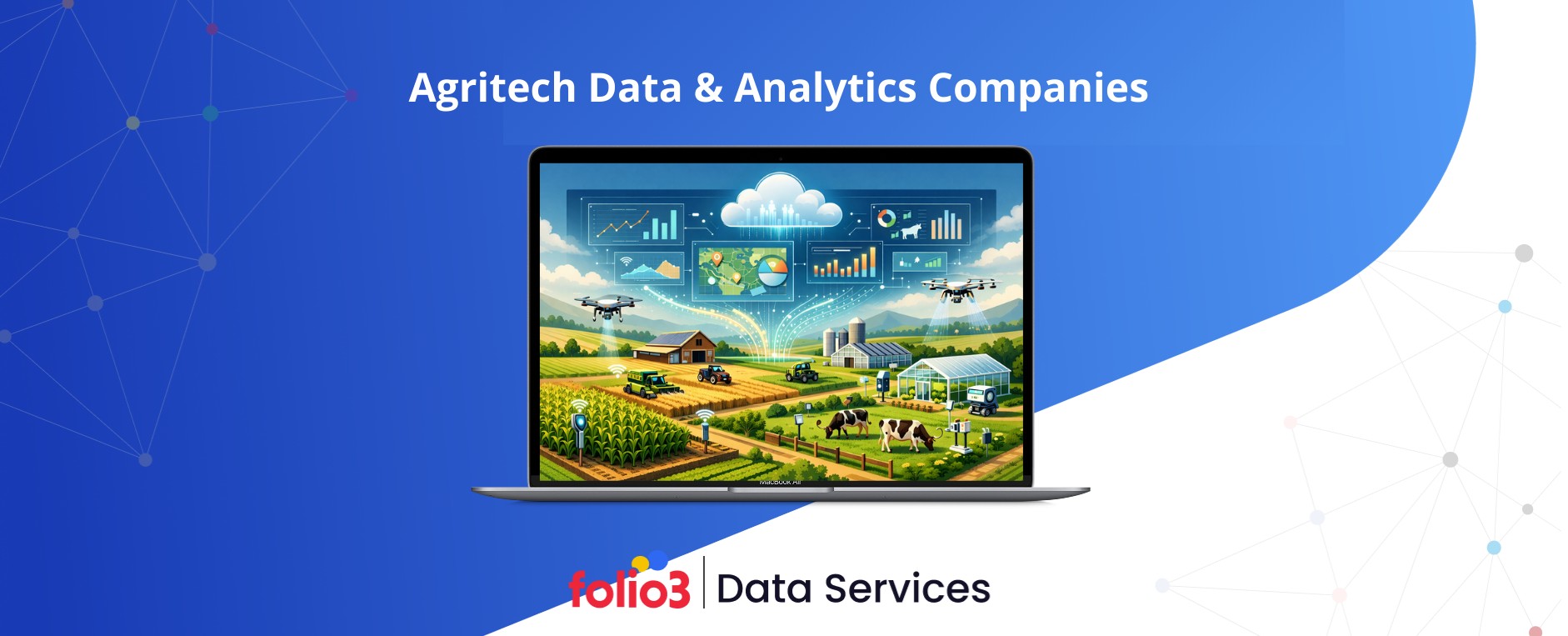

Modern farms are becoming data-native enterprises. From satellites and in-field IoT sensors to machine learning and cloud analytics, agritech data and analytics companies now turn raw field signals into decisions that improve yields, cut input waste, and strengthen resilience. Agritech data and analytics refers to the integrated use of sensors, satellite imagery, equipment telemetry, weather models, and AI/cloud platforms to optimize agronomic practices, automate workflows, and support sustainability outcomes across the farm-to-food value chain, as profiled by Spherical Insights. This guide spotlights 10 leading providers transforming farm management with precision agriculture, data-driven agritech, and farm data analytics—offering clear, impartial comparisons for senior data leaders evaluating their options.
1. Folio3 Data Services for Agritech Innovation
Folio3 Data partners with agribusinesses to design and run end-to-end data platforms—ingesting heterogeneous farm data, engineering reliable pipelines, and operationalizing analytics and ML for measurable ROI. We modernize legacy farm data systems, unify field and enterprise data, and deliver governed, scalable solutions on Snowflake, Databricks, and BigQuery.
What we deliver:
- Unified data platforms: integration of equipment telemetry, satellite/IoT, weather, ERP, and supply-chain data
- Real-time streaming and data engineering: low-latency ingestion, quality, lineage, MDM
- Advanced analytics: interactive dashboards, digital agronomy apps, and predictive modeling
- ML/AI enablement: yield prediction, input optimization, risk scoring, and anomaly detection
- Secure operations: access controls, audit trails, and compliance reporting
Representative use cases:
- Yield and quality forecasting by field and hybrid
- Variable-rate fertilizer and irrigation optimization
- Pest/disease risk prediction and scouting prioritization
- Carbon/sequestration accounting and sustainability reporting
- Claims, traceability, and regulatory compliance analytics
Explore our agriculture data analytics services to see how we accelerate time-to-value with pragmatic roadmaps and collaborative delivery.
2. The Climate Corporation – Climate FieldView
The Climate Corporation’s FieldView platform integrates equipment telemetry, satellite imagery, and analytics for yield analysis and prescription mapping, as summarized in Farmonaut’s roundup of AI tools in agriculture. Farmers value the strong OEM integrations, device-based subscriptions, and real-time agronomic tools that turn machine and imagery data into variable-rate recommendations. Reported outcomes include 10–20% yield improvements in certain crops and geographies when paired with precise prescriptions and timely execution, with the caveat that legacy data harmonization and API mapping are essential for reliable analytics at scale.
Feature comparison snapshot:
| Capability | FieldView | John Deere Operations Center | Farmers Edge |
| Equipment integration | Broad, multi-OEM compatibility via adapters and APIs | Deep, native with Deere fleet; supports mixed fleets via partners | Works across OEMs with telematics kits |
| Satellite imagery | High-frequency imagery for scouting and zone creation | Integrated satellite feeds for ops planning | Core to scouting, zone creation, and risk modeling |
| Variable-rate prescriptions | Strong support for seeding, fertilizer, and fungicide | Robust with Deere equipment and third-party partners | Built-in VRA and zone management |
| Mobile/offline | Strong mobile apps; offline field data capture | Mobile and web; strong machine sync | Mobile apps with device-based sync |
| Pricing model | Device-based subscriptions and tiers | Freemium to enterprise tiers | Subscription with module add-ons |
| Notable strengths | Ease of use, actionable field analytics | Fleet intelligence + agronomy in one | Integrated imagery + weather + IoT bundle |
| Key considerations | Legacy data mapping, cross-system APIs | Mixed-fleet integration complexity | Local calibration, data interoperability |
Source: Farmonaut’s roundup of AI tools in agriculture.
3. Indigo Ag
Indigo Ag combines digital platforms and microbiology, offering carbon measurement and marketplace services that monetize regenerative practices, according to Spherical Insights. The company pairs agronomic analytics with market access: Indigo Carbon helps quantify outcomes and connect farmers to buyers for verified environmental attributes. AI and ML underpin large-scale monitoring of soil health and practice adoption. Strengths include its end-to-end sustainability value chain; considerations involve integration with on-farm data systems and rigorous verification workflows for enterprise-grade reporting.
4. John Deere Operations Center
John Deere Operations Center is a cloud platform that connects Deere equipment, in-field sensors, and satellite feeds with analytics for plowing, planting, spraying, and harvest optimization. As discussed in Sparx IT Solutions’ overview of AI in agriculture, Deere increasingly augments operations with AI-powered machinery and autonomy, turning telemetry into prescriptive actions. Many enterprises value the combination of fleet management and agronomic insights, especially when these insights are surfaced through operational dashboards similar in concept to real-time herd analytics dashboards used in livestock systems. Practical constraints can include connectivity for real-time updates and data mapping when blending Deere and non-Deere datasets.
5. CropX
CropX pairs advanced soil sensors with analytics to help farmers optimize irrigation and fertilization at the site level, highlighted in SAIWA’s guide to agriculture data analytics companies. Users often see 10–20% input reductions and measurable yield improvements when following sensor-informed scheduling and nutrient recommendations. The platform emphasizes quick sensor installs, remote device management, and intuitive dashboards; for best results, local calibration and soil characterization improve model accuracy.
6. Farmers Edge
Farmers Edge integrates satellite imagery, IoT sensors, and predictive weather to inform input optimization and risk management, noted in Morning Ag Clips’ AgTech data engineering feature. Core analytics include pest and disease risk modeling, climate insights, and yield forecasting delivered through a subscription model with enterprise integration options. Organizations appreciate the breadth of bundled data sources; typical challenges involve interoperability with legacy systems and ensuring localized model performance in complex microclimates.
7. Sentera
Sentera combines in-house sensors, drones, and analytics platforms to transform field imaging into actionable agronomic insights, as described by SAIWA. Its strengths include rapid disease scouting, trait monitoring for R&D plots, and support for organizations that outsource breeding analytics while still needing high-resolution field intelligence. The company is known for delivering near real-time, high-resolution imagery and derived indices that slot into existing agronomic workflows.
8. Apollo Agriculture
Apollo Agriculture bundles insurance, agronomic advice, financing, and inputs for smallholders using mobile, satellite, and machine learning, according to Spherical Insights. Analytics drive scalable risk assessment and underwriting while tailoring recommendations to local conditions. Across African markets, Apollo’s model has helped overcome barriers to data-led decisions on small farms by simplifying access to credit, inputs, and advisory services in a single digital experience.
9. OneSoil
OneSoil leverages frequent satellite analytics to power yield forecasting, variable rate fertilizer maps, and cost-savings recommendations, and is profiled by Omdena’s precision agriculture companies list. In one example, a Ukrainian agribusiness saved 200 tons of fertilizer and approximately $300,000 by adopting variable-rate strategies guided by OneSoil’s analytics. Strengths include rapid onboarding, clear ROI, and benchmarking tools that reveal field-to-field performance gaps.
10. Arable
Arable Analytics transforms localized weather and crop sensor data into actionable agronomic alerts and insights. Drawing on industry roundups such as Omdena’s coverage, Arable supports disease risk prediction, phenology modeling, and irrigation scheduling with hyperlocal resolution that complements satellite and equipment data. For enterprise users, cloud-native APIs and data exports ease integration with BI tools, data platforms, and livestock feed management data pipelines to ensure coordinated decision-making across farm operations.
Frequently Asked Questions
What are the key benefits of using agritech data and analytics platforms?
Agritech analytics platforms help farmers and enterprises increase yields, reduce input costs, and make data-driven decisions for greater operational efficiency and sustainability.
How do agritech companies integrate AI and machine learning in farming solutions?
Most leading agritech solutions apply AI and machine learning to process sensor and satellite data, predict yields, optimize resource use, and deliver tailored agronomic recommendations.
What challenges exist when adopting data and analytics technologies in agriculture?
Common challenges include legacy system integration, ensuring local data accuracy, connectivity requirements for real-time analytics, and building user trust in AI-generated insights.
How do subscription and pricing models vary among agritech analytics providers?
Pricing models may be subscription-based, device-based, or enterprise-integrated, ranging from a few hundred to several thousand dollars annually depending on farm size and features.
What is the role of data-driven decision-making in improving farm sustainability and yields?
Data-driven decision-making enables farmers to optimize every stage of production, leading to improved resource efficiency, reduced environmental impact, and measurable yield gains.
Conclusion
Modern farms rely on data—from sensors, satellites, and AI—to optimize yields, reduce waste, and drive sustainability. Agritech analytics platforms turn these diverse signals into actionable insights for smarter, faster decisions across the farm-to-food value chain.
Folio3 Data Services empowers agribusinesses with end-to-end data solutions, unifying field, IoT, and enterprise systems. By delivering real-time pipelines, AI-driven analytics, and predictive insights, Folio3 helps farms streamline operations, improve yields, and achieve measurable ROI.