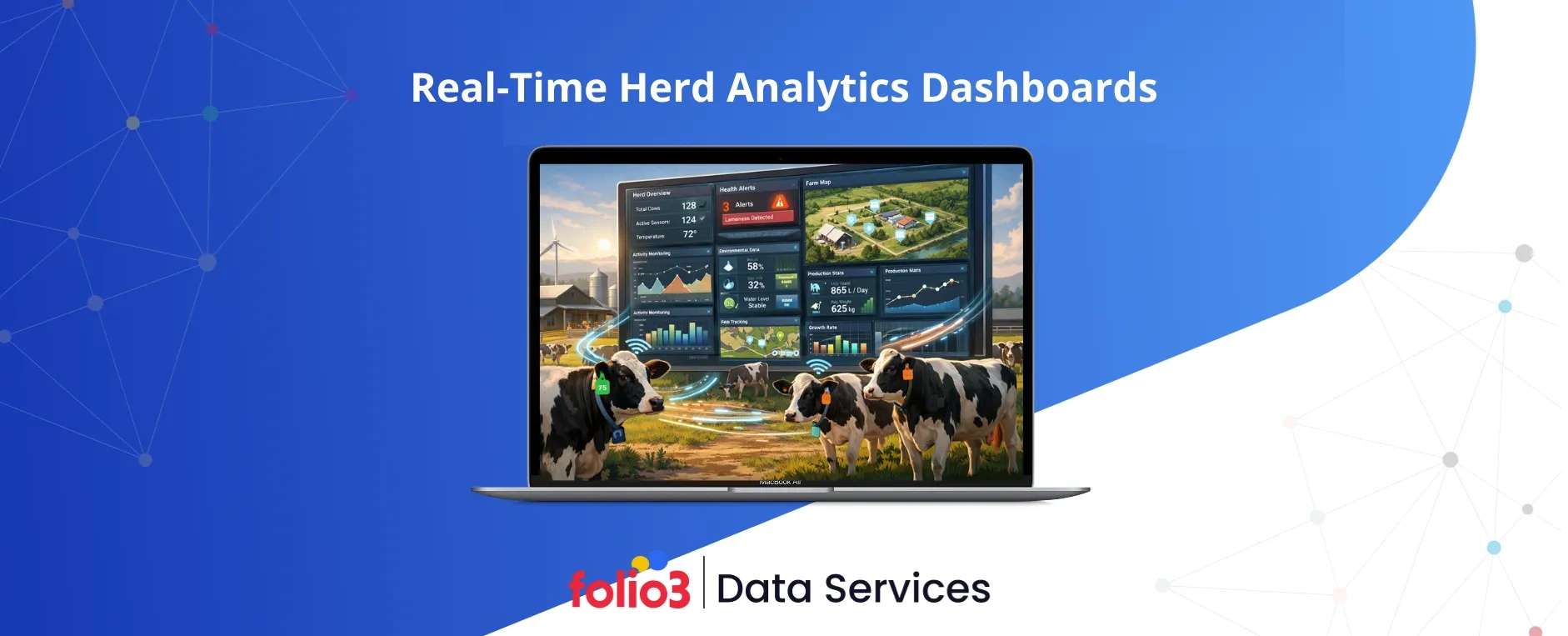

Real-time herd analytics transforms animal telemetry into actionable decisions: early disease detection, optimized feed, tighter grazing, and higher yields. This guide shows farm operators and data leaders how to build custom herd performance dashboards for farms—from data capture to live visualization—ensuring each role sees the right metrics at the right moment. We outline scalable architectures, the KPIs that matter, and the appropriate timing for adding predictive and digital-twin features. If you prefer a faster approach, Folio3 Data designs and operates enterprise-grade livestock analytics platforms. We leverage a consultative approach that aligns data engineering, AI, and on-farm workflows to ROI.
Define Objectives, Audience, and Key Performance Indicators
Great dashboards start with intent. Ask, ‘What questions must the dashboard answer?’—a simple rule of focus emphasized in analytics and web dashboard design best practices. Align the dashboard to one primary goal at a time: reduce disease impact, optimize feed conversion, cut mortality, improve welfare compliance, or increase milk/meat yield.
Map stakeholder needs before selecting herd management KPIs:
- Herders: headcounts, location heatmaps, geofences, stray alerts.
- Veterinarians: lameness/gait alerts, temperature changes, treatment adherence.
- Operations executives: feed-to-yield ratios, cost per kilogram of gain, mortality/cull rates, forecasts.
- Nutritionists: feed intake, bunk score deviations, ration adherence.
- Sustainability/QA: antibiotic usage, welfare incidents, emissions intensity.
Keep each role’s dashboard to 5–10 critical livestock dashboard metrics; too many metrics lead to dashboard neglect Web analytics dashboard best practices. This discipline drives adoption and faster decisions across stakeholder analytics.
Inventory Data Sources and Service Level Agreements
Inventory every real-time data feed and agree on service levels so “real time” aligns with the task at hand. Typical IoT herd data sources include GPS collars, RFID readers, drones, camera systems, rumination/temperature biosensors, and pasture/environmental monitors—patterns consistent with proven observability and BI practices that incorporate domain-specific feeds Open-source dashboards roundup.
Define “real time” per workflow: seconds for health/stray alerts, minutes for feeding and grazing moves, hourly for forecasts. Real-time means data is updated as soon as available, typically within seconds or minutes depending on the use case.
Suggested SLAs and alerting targets:
| Source | Typical Refresh Rate | Target Latency to Dashboard | Alerting Notes |
| GPS collars | 5–60 seconds | <10 seconds | Geofence breach, stray, inactivity |
| RFID chutes/readers | Event-based | <5 seconds | Identity verification, movement logs |
| Drones (video/thermal) | Per flight/stream | <5–15 seconds (streaming) | Count anomalies, heat stress, trespass |
| Fixed cameras (CV) | 1–5 seconds | <5 seconds | Headcount, lameness/gait anomalies |
| Biosensors (rumen/temp) | 1–5 minutes | <1 minute | Fever, low activity, calving alerts |
| Feed/bunk sensors | 1–15 minutes | <5 minutes | Intake dips, ration deviation |
| Weather/pasture monitors | 5–15 minutes | <5 minutes | Heat index, pasture growth, water levels |
| ERP/ELD/health records | Event/hourly | <15 minutes | Treatments, inventories, compliance checks |
These telemetry pipelines and real-time data feeds become your foundation for trustworthy dashboards and dependable alerts.
Design Streaming Ingestion and Real-Time Processing Pipelines
Use a scalable, low-latency architecture: “lightweight edge capture → streaming ingestion → a real-time processing/serving layer → analytics store + real-time APIs → visualization and alerting”. Streaming ingestion is the continuous, real-time movement of data from source devices into storage and analytics systems.
- Ingestion: Frameworks like Tinybird and Kafka enable low-latency transforms and real-time endpoints that power live dashboards Real-time dashboard architecture guide.
- Processing: Separate microservices enhance modularity and scalability. Microservices are advantageous for herd analytics; examples include herd-detector, stray-alert, gait-analyzer, and data-anonymizer Real-time herd counting overview.
- Serving: Expose pre-aggregated streams and metrics via low-latency APIs to guarantee predictable UI performance.
- Reliability: Idempotent processing, schema contracts, and dead-letter queues maintain data integrity.
This streaming analytics pattern supports immediate decisions today and advanced models tomorrow.
Implement Storage and Real-Time Materialized Views
Keep operational costs low and performance high with the right storage and data modeling in an agriculture data analytics solution:
- Store raw telemetry in a cost-effective, append-only layer (cloud object store plus partitioned tables) to preserve history and minimize expenses Real-time herd counting overview.
- Publish computed metrics through real-time materialized views or API endpoints to avoid costly ad-hoc queries on high-cardinality streams Real-time dashboard architecture guide.
Materialized views are precomputed, rapidly accessible summaries that update as new data arrives. A pragmatic flow:
- Raw ingestion
- Pre-processing/validation
- Partitioned storage in a cloud object store and analytic store
- Materialized real-time views and metrics endpoints
This gives you a real-time database feel for hot data without overspending on every query.
Develop APIs and Microservices for Dashboard Data Delivery
Dashboards should consume governed, purpose-built data, not raw streams. Build APIs that sit cleanly on top of the livestock feed management data pipeline to ensure consistency, performance, and access control:
- REST endpoints for metrics, time series, and role-specific summaries.
- Real-time endpoints using WebSockets or efficient HTTP polling for alerts and live maps.
Support compliance with privacy microservices (e.g., data-anonymizer) that blur faces or plates in drone footage and filter sensitive GPS windows Real-time herd counting overview.
Common livestock analytics endpoints and services:
- herd-detector: headcounts, density, location clusters
- stray-alert: geofence detection and escalation
- gait-analyzer: lameness risk scoring from CV
- data-anonymizer: video/image redaction, ID masking
These dashboard APIs and livestock analytics endpoints effectively decouple UI evolution from back-end changes.
Create Dashboards and Visualization with Role-Based Access
For operational monitoring, Grafana remains the industry-standard open-source dashboard in 2026, offering rich real-time panels and alerting, as highlighted in open-source dashboard roundups. For governed BI, Folio3 Data recommends Power BI or Looker for enterprise use cases Best dashboard software overview.
Role-based access ensures the right view per user: executives need aggregated refreshes and forecasts; herders need live maps and alarms Web analytics dashboard best practices.
Platform comparison
| Platform | Best For | Key Features | Integration Notes |
| Grafana | Live ops and alerts | Real-time panels, alerting, wide plugins | Excellent for IoT and time series (Prom/TSDB) |
| Power BI | Governed enterprise reporting | Semantic models, RLS, strong Microsoft stack | Native with Azure; gateways for on-prem |
| Looker | Metrics layer and governed self-serve | LookML, consistent KPIs across teams | Strong BigQuery/Snowflake integrations |
| Tableau | Visual exploration | Rich visuals, interactivity, extensions | Broad connectors; server or cloud |
| Qlik Sense | Associative analysis at scale | In-memory engine, guided analytics | Good for complex multi-source analysis |
Folio3 Data can implement Grafana for livestock operations and BI dashboards with role-based access, unifying metrics across both.
Folio3 designs and operates enterprise-grade livestock analytics platforms that turn raw telemetry into live dashboards, alerts, and predictive insights.
Validate, Iterate, and Integrate Predictive Analytics Features
Validate dashboards on-farm, iterate models with ground-truth data, and integrate predictive/digital-twin features as foundations mature precision dairy research program.
Definitions:
- Predictive analytics uses algorithms on historical and real-time data to forecast events like lameness, heat stress, or calving.
- A digital twin is a virtual replica of an animal, herd, or farm system used to simulate interventions and optimize health and production.
Current research targets include cow social networks and digital twins for disease control. With dairy-sector losses from prevalent diseases estimated at over $2 billion annually, decision-driven analytics quickly justify investment in the Precision dairy research program.
When you’re ready to extend beyond monitoring, Folio3 Data offers real-time model validation, livestock digital twin design, and MLOps integrated into a single roadmap. For related context, see our overview of leading breeding analytics providers.
Frequently Asked Questions
What does real time mean in the context of herd analytics dashboards?
Real time means data is captured and visualized within seconds or minutes, enabling immediate responses to health, safety, or operational events.
How can I ensure data privacy and security when capturing herd telemetry?
Utilize privacy filters and data-anonymization methods, enforce role-based access, and deliver governed data via secure APIs rather than exposing raw streams.
What are the best tools for visualizing real-time livestock data?
Use Grafana for live operational monitoring and Power BI or Looker for governed, role-based analytics across teams.
How do I select the right KPIs for different stakeholders on the farm?
Collaborate with each role to design tailored KPIs, then limit each dashboard to 5–10 KPIs that directly support their decisions and actions.
When should predictive and digital-twin models be incorporated into herd analytics?
Incorporate these models after establishing reliable pipelines and dashboards, adding them once you have strong ground-truth validation to maintain accuracy and trust.
Conclusion
Real-time herd analytics dashboards turn raw animal telemetry into fast, actionable decisions that improve health, productivity, and operational efficiency. By defining clear objectives, selecting the right KPIs, and building scalable streaming pipelines, farms can deliver the right insights to the right people at the right time. The most successful dashboards are simple, role-based, and built on reliable data ingestion, governance, and performance.
Once the foundation is strong, farms can confidently add predictive analytics and digital twins to anticipate risks and optimize outcomes. If you want to accelerate this journey, Folio3 Data Services designs and operates enterprise-grade livestock analytics platforms that align data engineering, AI, and on-farm workflows for measurable ROI.