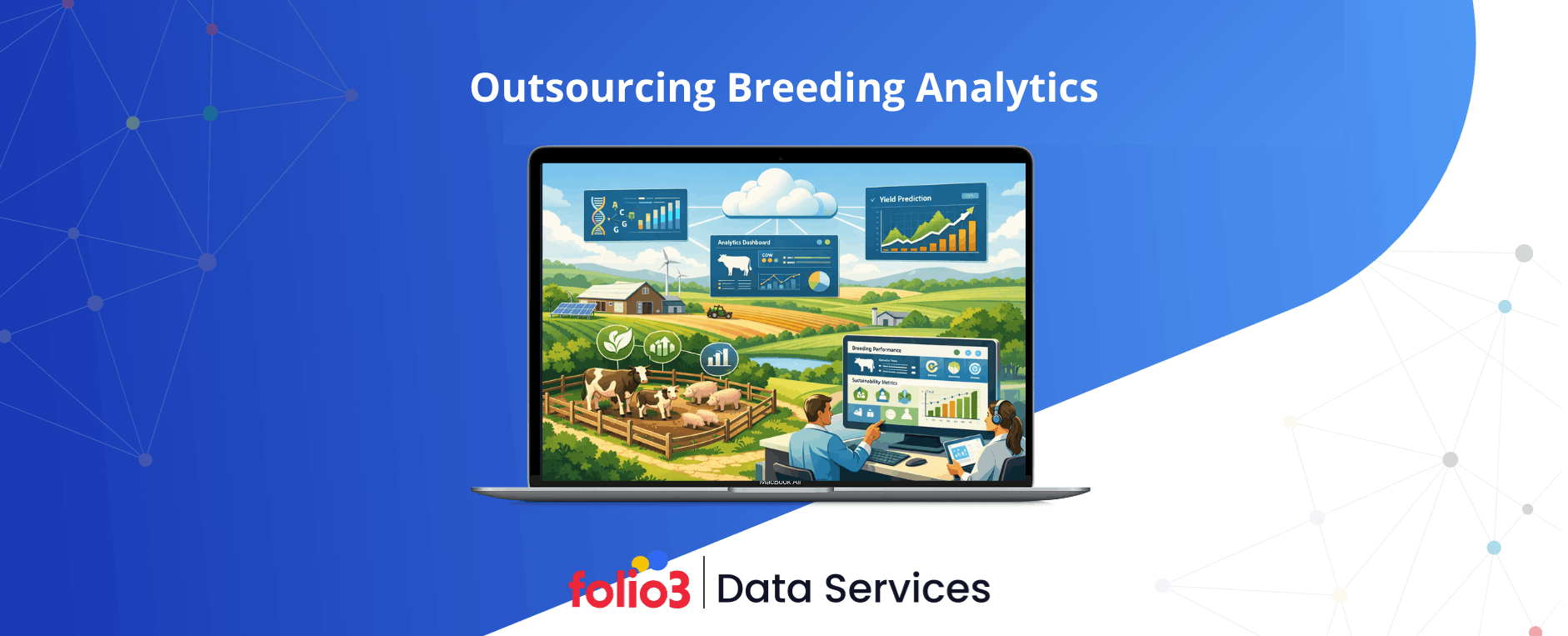

Outsourcing breeding analytics can accelerate genetic gain, reduce operational overhead, and translate sustainability mandates into measurable outcomes. By tapping specialized platforms and expert services, agri-enterprises can unify fragmented datasets, apply AI at scale, and shorten cycle times without building every capability in-house. This article reviews seven top-rated providers covering plant and animal programs—from genomic selection to herd-level decision support—so you can match capabilities to your strategy and budget. At Folio3 Data, we empower leaders to evaluate, integrate, and operationalize these solutions for ROI-focused impact.
Strategic Overview
Breeding analytics uses data science, AI, and cloud-based tools to optimize selection, crossbreeding, and herd or crop management. These solutions transform fragmented field, lab, and operational data into actionable insights for improved yield, sustainability, and genetic diversity. Adoption is accelerating as programs modernize pipelines and enable genomic prediction, with organizations like CGIAR reporting that data analytics is transforming crop breeding end-to-end, from trial design to variety release (see CGIAR’s overview on analytics in crop breeding).
Market tailwinds strengthen the case for outsourcing: agriculture analytics is a fast-growing segment as producers digitize operations and expand AI-powered farm tools (Grand View Research’s agriculture analytics outlook). Meanwhile, genomic selection continues to deliver higher selection accuracy and faster genetic progress compared to phenotypic selection alone (IMRPress’ review on genomic selection in agriculture).
| Provider | Primary Focus | Best For |
| Folio3 Data Agriculture Analytics Solutions | Unified analytics across crop, livestock, equipment, and supply chain; AI queries and predictive insights | Enterprises needing end-to-end, sustainable breeding analytics with deep integration |
| Diversity Arrays Technology (DArT) | Genotyping and genomic selection pipelines for advanced plant programs | Research-intensive plant breeding and molecular genetics teams |
| Integrated Breeding Platform (IBP / BMS Pro) | Trial and pedigree management; collaborative workflows | Multi-institutional programs and developing-region capacity building |
| Agro Business Solutions (ABS) | ERP-style suite across breeding, trials, seed production, and distribution | Midsize to enterprise seed companies with distributed operations |
| Central Software Solutions (PRISM) | Highly customizable plant-breeding workflows and marker tracking | Teams needing tailored terminology and process control |
| PlantPassion ApS | Intuitive SaaS for rapid adoption and user-friendly analytics | Small-to-midsize stations, education, high-turnover teams |
| BreederCloud Pro | Budget-friendly animal breeding records and basic pedigrees | Small breeders prioritizing affordability and simplicity |
1. Folio3 Data Agriculture Analytics Solutions
Folio3 Data agriculture analytics platform unifies crop, livestock, field, equipment, and supply chain data in a modern, scalable architecture designed for sustainable, data-driven operations. Teams query data with natural-language, AI-powered prompts to surface insights without heavy technical lift, while predictive analytics support yield forecasting, risk identification, and early detection of inefficiencies in breeding and production workflows.
Interactive dashboards and flexible data mapping make it simple to compare performance across seasons, locations, and cohorts, enabling resource optimization and waste reduction. As an enterprise-ready solution, Folio3 Data supports secure, scalable deployment and integrates with existing agri systems, genomics pipelines, and BI/ML tools. The result: improved productivity, resilience, and long-term sustainability, with measurable ROI rather than one-off analytics projects.
2. Diversity Arrays Technology (DArT)
DArT is a market leader in genomic profiling and genotyping analytics for advanced plant breeding programs. Its lab-to-analysis services—spanning DNA extraction, genotyping, germplasm characterization, and genomic selection pipelines—deliver high-resolution molecular data that powers trait discovery and selection decisions. Genotyping is the process of determining genetic variation at specific locations in an organism’s DNA for selection and trait mapping in breeding programs.
The advantages are clear for cutting-edge plant breeding: deep, high-density markers and robust pipelines for genetic selection analytics and germplasm characterization. Potential trade-offs include higher per-sample costs and lab lead times. For programs prioritizing molecular precision and research-grade analysis, DArT offers a strong genomic selection service that complements on-farm tools and trial software.
DArT vs. typical on-farm tools
| Dimension | DArT (research-grade) | Typical on-farm tools |
| Data Type | High-density molecular markers | Phenotypic, environmental, operational |
| Use Cases | Genomic selection, QTL mapping, germplasm diversity | Field trial management, inventory, season planning |
| Turnaround | Lab-driven lead times | Near real-time operational reporting |
| Cost per Sample | Higher (lab and analysis fees) | Lower; subscription or per-seat |
| Expertise Required | Genetics and bioinformatics | Agronomy, farm operations, data ops |
3. Integrated Breeding Platform (IBP / BMS Pro)
IBP’s Breeding Management System (BMS Pro) supports collaborative breeding at a global scale, with robust trial design, data workflows, and pedigree management. Its open-access ethos and active user community make it especially valuable where capacity building is essential, such as multi-institutional programs across developing regions. BMS Pro excels at orchestrating repeatable workflows—from data collection through analytics—with cross-season marker tracking and standardized trait dictionaries that improve data quality and comparability over time. The platform’s strong reporting and dashboarding also helps link breeding outcomes to broader operational contexts like agricultural supply chain visualization, supporting downstream decisions on variety deployment and distribution.
As profiled in this roundup of plant breeding software, expect a mature suite for complex research trials and cross-team collaboration. New adopters should plan for thoughtful configuration and initial training to fully realize the platform’s capabilities.
4. Agro Business Solutions (ABS)
ABS delivers a modular, ERP-style suite spanning breeding, trials, production, seed, and fresh—enabling end-to-end operations for commercial seed companies. Mobile-first workflows and unified databases consolidate data across breeding cycles, trial networks, and supply chains, improving traceability and speed to market. The suite particularly benefits midsize to enterprise-level seed companies that operate across geographies and need consistent data models and process control. In many implementations, organizations pair ABS with specialized data analytics companies to build custom reporting and predictive models on top of the platform.
Where ABS fits best:
- Commercial seed producers with distributed field and lab operations
- Organizations prioritizing seed production analytics and inventory traceability
- Enterprises adopting an ERP breeding system to standardize global processes
5. Central Software Solutions (PRISM)
PRISM focuses on customization: tailored terminology, configurable workflows, and flexible marker and trait management. For plant-breeding programs that need bespoke vocabularies or have specialized processes, PRISM’s adaptability and responsive post-sale support are standout strengths. Marker management is the organization, tracking, and utilization of genetic markers to facilitate efficient trait selection and breeding decisions.
PRISM fits teams seeking process agility, modular growth, and future-proof scalability without sacrificing rigor. Compared to more rigid suites, the ability to align software with program-specific methods can accelerate user adoption and reduce shadow spreadsheets. PRISM’s configurable workflows also support a data analytics framework that standardizes how traits, markers, and results are captured, enabling consistent reporting and cross-season comparisons.
6. PlantPassion ApS
PlantPassion ApS offers an intuitive SaaS for plant-breeding teams that value rapid onboarding and user-friendly analytics. A modern UI reduces adoption friction, while guided workflows help standardize data capture and reporting. It’s a strong fit for high-turnover teams, educational programs, or small-to-midsize research stations that need agility without a heavy administrative burden. As breeding teams increasingly rely on data-driven decision making, PlantPassion’s focus on simplicity aligns well with broader data analytics trends, especially around low-code dashboards and collaborative insights.
7. BreederCloud Pro
BreederCloud Pro is an affordable SaaS option for small animal breeders seeking accessible recordkeeping, health logs, and basic pedigree features. Reviews highlight budget-friendly pricing around $4.99/month, with health reminders and image galleries that simplify day-to-day management (see BreederCloud Pro reviews). Reported limitations include the absence of an advanced pedigree builder and some onboarding issues, so teams should weigh simplicity against long-term depth.
BreederCloud vs. full-featured genomic tools
| Dimension | BreederCloud Pro | Full-featured genomic tools |
| Pricing | Low-cost monthly | Higher subscription and lab fees |
| Pedigree Depth | Basic | Advanced pedigree and marker analytics |
| Health Records | Logs, reminders, images | Integrated health-genomic decision support |
| Genomic Pipelines | Not included | Built-in or integrated with labs |
| Best For | Small breeders, budget-first | Research-grade selection and prediction |
How to Choose the Right Breeding Analytics Provider
- Best-of-breed vs. all-in-one: Many organizations struggle with tool fragmentation when forcing a single platform to fit every use case; evidence suggests over half encounter gaps that best-of-breed stacks can solve more effectively (see this best-of-breed vs. single provider analysis). Decide where depth (e.g., genotyping) vs. breadth (ERP-like control) matters most.
- Validate AI explainability, scalability, and integrations. Ensure models provide transparent feature importance, support edge/cloud scaling, and integrate with your BI/ML stack via robust APIs.
- Step-by-step decision flow:
- Needs assessment: Genomics-driven selection vs. operational management and reporting
- Data and API requirements: LIMS, sensor data, remote sensing, and ERP/finance integrations
- Pilot with real data: Run a time-boxed trial before subscription to verify accuracy, usability, and ROI (practical guidance echoed by this software selection primer for breeders).
Key Features to Evaluate in Breeding Analytics Solutions
Must-have capabilities:
- Genomic data pipelines: Ingestion, QC, variant calling/markers, and genomic prediction workflows
- Pedigree and marker tracking: Cross-season lineage, trait dictionaries, and marker-assisted selection
- AI-powered decision support: The use of artificial intelligence algorithms to predict optimal breeding cycles, identify genetic anomalies, and automate data-driven recommendations
- Multi-season/lifecycle data capture: Cohort-to-cohort comparability across environments and years
- Responsive support and training: Success playbooks, onboarding, and community forums
Many programs now incorporate remote sensing for high-scale phenotyping. Platforms like Farmonaut demonstrate how satellite-derived indices can enhance field observations for selection decisions. These same real-time data approaches can also support data pipelines for livestock feed management in integrated farm systems.
Feature comparison (summary view)
| Provider | Genomic Pipelines | Pedigree/Marker Tracking | AI Decision Support | Multi-Season Capture | Support/Training | Best For |
| Folio3 Data | Integrates with lab/genomic tools | Yes (cross-entity) | Yes | Yes | Enterprise-grade | Integrated, enterprise analytics |
| DArT | Yes (lab-to-analysis) | Yes (molecular focus) | Genomic prediction | Partial (research datasets) | Expert lab support | Molecular plant programs |
| IBP / BMS Pro | Integrates; marker workflows | Yes | Limited (rules/analytics) | Yes | Strong community | Collaborative research |
| ABS | Integrates (ERP context) | Yes | Moderate | Yes | Enterprise services | Seed companies |
| PRISM | Integrates; configurable | Yes (highly flexible) | Moderate | Yes | Responsive support | Custom processes |
| PlantPassion | Limited genomic scope | Yes (intuitive) | Basic | Yes | Easy onboarding | Smaller teams |
| BreederCloud Pro | No | Basic pedigrees | No | Basic | Self-serve | Small breeders |
Benefits of Outsourcing Breeding Analytics for Sustainable Farming
Digital, outsourced approaches can slash costs and time-to-insight: field-trial platforms report 24%–71% lower trial costs, 30%–55% fewer data errors, and 50%–95% faster results through standardized, cloud-based workflows (QuickTrials’ efficiency metrics). Outsourcing also offloads infrastructure, accelerates access to specialized genomics in agriculture, and supports explainable AI without expanding internal teams.
Business and environmental ROI compound as organizations unlock faster genetic improvement, climate-resilient breeding, and streamlined compliance reporting. Core sustainability outcomes include improved resource efficiency, greater biodiversity, and measurable environmental impact—key for long-term sustainability strategies in farming data strategies and outsourced genomic analysis aligned with ESG goals.
Frequently Asked Questions About Outsourcing Breeding Analytics
What are the top providers for outsourcing breeding analytics?
Leading options span plant and animal programs, including Folio3 Data, DArT, and the Integrated Breeding Platform; each targets distinct needs from herd management to genomic selection.
How does outsourcing breeding analytics improve sustainable farming?
It gives teams access to advanced analytics and genomics, speeding cycles while supporting genetic diversity and climate resilience at a lower cost per unit of genetic gain.
What cost savings can be expected?
Many programs achieve 24%–71% lower trial management costs alongside faster results and fewer data errors with digital outsourcing.
What technologies do these providers use?
Common technologies include AI, genomic selection, marker-assisted selection, trial management software, and cloud analytics for end-to-end decision support.
Is outsourcing suitable for small farms or research programs in developing regions?
Yes; several providers offer low-cost tools and capacity-building services that fit smallholders and multi-institution programs in developing regions.
How should I choose the right provider?
Define requirements, compare features and integrations, and pilot with your real data to validate usability, accuracy, and support.
What are the risks or limitations of outsourcing breeding analytics?
Up-front onboarding and integration effort can be nontrivial, but efficiency gains and improved genetic outcomes typically outweigh these challenges.
Conclusion
Outsourcing breeding analytics is a powerful way for farming organizations to accelerate genetic gain, reduce operational overhead, and make sustainability goals measurable and actionable. The seven providers reviewed here span the full spectrum of needs—from genomic selection and trial management to ERP-style breeding operations and affordable animal recordkeeping. The right partner depends on your program’s scale, data maturity, and long-term breeding strategy.
Folio3 Data Services helps enterprises evaluate and integrate these solutions into a unified, scalable analytics stack, enabling faster cycle times, stronger decision support, and measurable ROI. By combining specialized tools with expert data engineering and AI workflows, you can modernize breeding programs while improving resilience, productivity, and environmental impact.