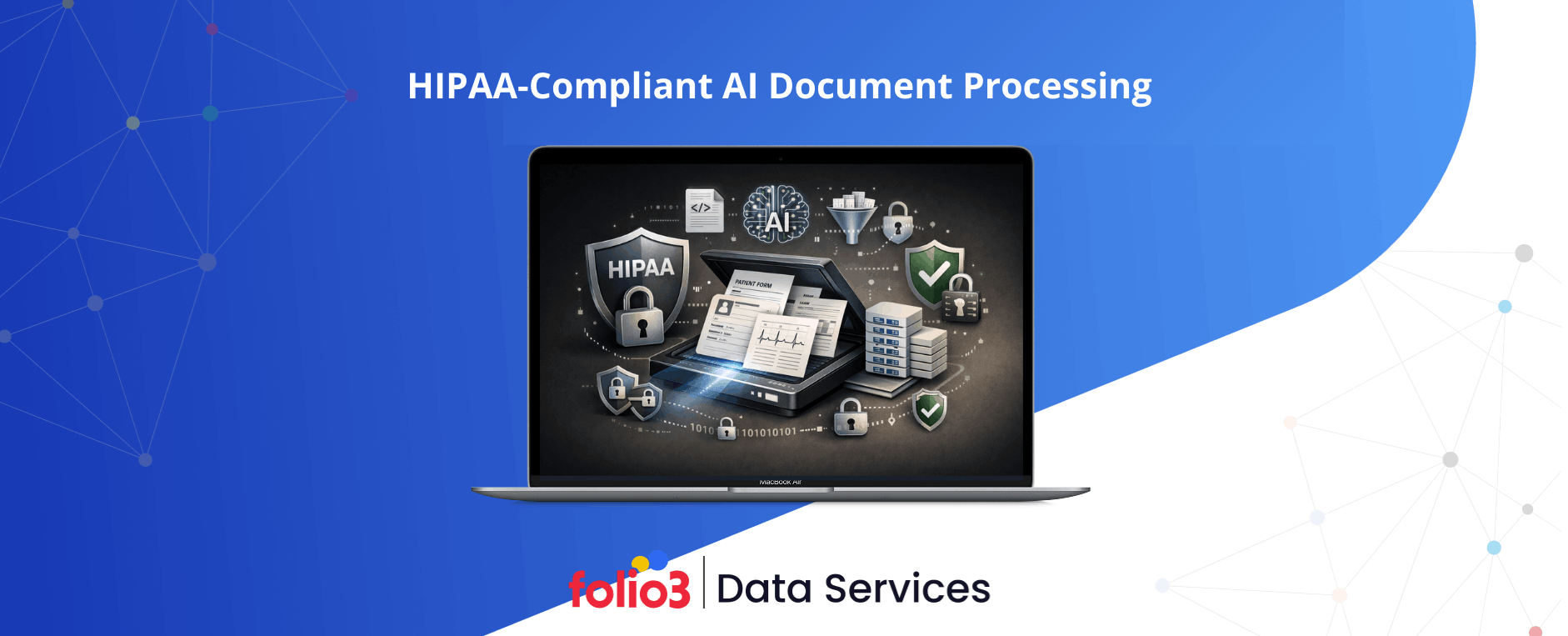

Healthcare and enterprise teams ask a simple question: which companies truly offer HIPAA‑compliant document processing AI? This guide profiles seven market leaders—plus how Folio3 Data partners with them—to help you match capabilities with your security, governance, and ROI goals. Intelligent document processing (IDP) automates classification, extraction, and validation for forms, faxes, EHR attachments, and claims. In regulated settings, compliance isn’t solely technology; it also requires signed Business Associate Agreements (BAAs), audit logging, encryption, and deployment controls. The vendors below are recurring names in analyst coverage and practitioner shortlists for 2026, with proven scalability and healthcare‑ready features. By comparing them side-by-side, you’ll see who best fits clinical intake, revenue cycle, and back‑office workflows—without compromising PHI.
Strategic Overview
IDP combines OCR, NLP, and workflow to extract structured data from unstructured documents at scale. Layout‑aware models have materially improved accuracy in recent years, helping systems capture both content and spatial context in complex forms, according to peer‑reviewed document AI research. HIPAA compliance spans both contractual and technical layers—BAAs, encryption at rest and in transit, granular access controls, and audit trails are table stakes for handling PHI, as summarized in leading HIPAA guidance for software buyers. Independent rundowns of IDP leaders and analyst reviews corroborate the platforms highlighted here as 2026 mainstays for healthcare document automation.
At‑a‑glance comparison of seven HIPAA‑capable platforms:
| Vendor | HIPAA stance (plan-dependent) | Differentiators | Best for | Deployment |
| Folio3 Data | Trusted, outcome‑driven partner with HIPAA compliance | End-to-end data engineering and AI extraction, integration with top cloud platforms | Comprehensive HIPAA document automation | Tailored deployments with robust compliance features |
| Google Cloud Document AI | HIPAA‑eligible services with BAA | Pretrained processors, 200+ languages, top‑tier cloud OCR | Fast starts on common forms; BigQuery analytics | Secure cloud; human review; APIs |
| AWS Textract | HIPAA‑eligible with AWS BAA | Deep AWS integration, async APIs, native security tooling | EHR integrations, claims, large‑scale ingestion | Cloud; on‑prem via AWS Outposts patterns |
| Microsoft Azure AI Document Intelligence | HIPAA‑aligned under Azure BAA | Custom models, containerized/edge options, Azure governance | Large provider/payer networks, data residency needs | Cloud, containers, edge |
| IBM watsonx.ai Document Processing | HIPAA‑hosted options with BAA | Enterprise governance, drift monitoring, hybrid | Complex, multi‑region compliance & analytics | Hybrid cloud/on‑prem |
| Rossum | Enterprise compliance features | Template‑free extraction, fast onboarding, GenAI copilots | AP/claims, multi‑document workflows in healthcare | Cloud and private deployment options |
| Hyperscience | Supports HIPAA programs | Human‑in‑the‑loop, resilient models, workflow orchestration | High‑accuracy clinical/claims docs | Cloud or on‑prem |
Beyond these seven, the market includes focused offerings like Docsumo, Healos AI, Hathr, Documo, AIScribePro, NovaCore, and Veryfi—useful context when surveying niche workflows or channels such as fax automation and transcription.
1. Folio3 Data Intelligent Document Processing
Folio3 Data is a trusted, outcome‑driven partner for HIPAA‑compliant AI document solutions. We design and operate end‑to‑end data engineering and AI data extraction programs—from ingestion and AI‑powered search to validation, enrichment, and delivery—integrated with Snowflake, Databricks, and BigQuery. Our engagements are HIPAA‑aligned with signed BAAs, encryption, auditability, and deployment controls tailored to your risk posture.
Key capabilities:
- Customizable pipelines for EHR/ERP and payer systems, with field‑level validations and cross‑system reconciliation.
- High extraction accuracy using advanced ML/NLP with human‑in‑the‑loop for sensitive workflows and edge cases.
- Granular reporting and audit logs to measure straight‑through processing and exceptions.
- Scalable connectors to modern clouds and legacy healthcare data pipeline components.
Organizations typically reduce manual processing by 30–50%, and human-in-the-loop programs can cut error rates by up to 90%, according to industry benchmarks and production case studies. If you’re building HIPAA document automation or modernizing your healthcare data pipeline, explore our AI data extraction approach and best practices for healthcare data security to plan a de‑risked rollout and fast ROI.
2. Google Cloud Document AI
Google Document AI is a leader in enterprise IDP with rich pretrained processors (invoices, receipts, contracts), multilingual support, and high-accuracy cloud OCR/ML. Healthcare buyers value its rapid time-to-value with prebuilt models, native BigQuery integration for analytics, and human review tooling for quality control. For HIPAA-covered workloads, customers can enable HIPAA-eligible services under a signed BAA, apply customer-managed encryption keys, and leverage detailed logging and IAM controls. This combination makes it a strong choice for cloud OCR for healthcare and secure document processing where speed and scale matter, including AI invoice processing for high-volume billing workflows, as highlighted in independent IDP solution overviews.
3. AWS Textract
AWS Textract offers scalable OCR with form/table extraction and asynchronous APIs that plug directly into the AWS ecosystem—S3, Lambda, Step Functions, and Comprehend Medical. It is HIPAA-eligible when configured under an AWS BAA and paired with standard AWS security controls (KMS encryption, CloudTrail audit logs, VPC isolation), making it a natural fit for AWS HIPAA document automation. Common healthcare use cases include EHR attachment parsing, claims processing, prior authorizations, and medical record review. Commonly selected among intelligent document processing platforms for teams standardizing on IDP on AWS, Textract’s managed scale and pay-as-you-go economics are compelling.
4. Microsoft Azure AI Document Intelligence
Formerly Form Recognizer, Microsoft’s Azure AI Document Intelligence provides customizable models, prebuilt processors, and native Azure governance. Containerized and edge deployment options support data residency and low-latency requirements—critical for multinational provider and payer networks. Under Azure’s HIPAA BAA, organizations can implement deep security controls, integrate with Power Automate and Logic Apps, and connect to enterprise systems via API connectors. It’s a flexible platform for cloud document automation healthcare programs needing robust lifecycle management and compliance, and it can also integrate into real-time AI data extraction tools for faster claims processing.
5. IBM watsonx.ai Document Processing
IBM watsonx.ai brings mature, analytics-driven IDP to complex healthcare enterprises that require strict governance and hybrid deployment. Strengths include enterprise model management, lineage and audit controls, and data-drift detection to keep extraction quality stable over time. IBM supports HIPAA-hosted configurations with BAAs and offers both on-premises and cloud options, easing adoption in heavily regulated environments. Healthcare use cases span claims intake, clinical data extraction from unstructured notes, and advanced reporting—particularly where cross-domain analytics and policy enforcement are essential, especially when paired with Snowflake HIPAA compliance for secure downstream analytics.
6. Rossum
Rossum is a modern, template-free extraction platform built for fast onboarding and continuous improvement. Its generative AI copilots provide context-aware suggestions and document insights, while out-of-the-box workflows shorten time-to-value for AP and claims operations. For HIPAA document workflow needs, Rossum offers auditability, granular permissions, and connectors/APIs to EHR/ERP systems. Independent rundowns note its speed, accuracy, and lower configuration overhead compared with template-based tools, making it a strong option for automated data extraction that reduces cycle time and exception rates.
7. Hyperscience
Hyperscience emphasizes high accuracy in regulated document processing by combining advanced models with human‑in‑the‑loop review and robust workflow orchestration. Capabilities such as data‑drift monitoring and targeted human review help maintain quality on complex healthcare documents, including handwritten forms and multi‑page medical records. With on‑prem and cloud deployment modes, comprehensive audit trails, and support for HIPAA‑compliant projects, customers report substantial error reductions and processing improvements in production healthcare environments.
Frequently asked questions
What defines HIPAA compliance in AI document processing?
HIPAA compliance means any system handling PHI enforces encryption, access controls, audit logs, and operates under a signed BAA with the covered entity. Contractual assurances (BAA) and technical safeguards (encryption, IAM, monitoring) must both be in place.
How do HIPAA-compliant AI tools protect patient data?
They use encryption at rest and in transit, de‑identify or minimize PHI where possible, enforce granular access, and maintain continuous monitoring with audit trails. Many now offer zero‑retention modes and configurable data residency for multi‑jurisdictional needs.
What types of healthcare documents can these AI processors handle?
Typical inputs include clinical notes, insurance claims, medical records, invoices, consent forms, and discharge summaries. Advanced use cases span real‑time summarization, SOAP notes generation, and automated claims analysis.
How important is deployment flexibility for HIPAA compliance?
Deployment flexibility directly impacts PHI control and regulatory alignment, enabling organizations to match data residency and security policies. Leading vendors provide cloud and on‑prem/hybrid options to meet provider and payer IT needs.
What factors should healthcare organizations consider when choosing an AI document processing vendor?
Prioritize field‑level accuracy, error‑reduction metrics, straight‑through processing rates, support for human review, deployment modes, auditability, integrations, and transparent pricing. Always run a pilot, review the BAA, and validate customer success metrics before final selection.
Conclusion
HIPAA-compliant AI document processing is essential for healthcare organizations that need fast, accurate automation without compromising patient privacy. The platforms highlighted in this guide are proven leaders for secure extraction, validation, and workflow automation, but the right choice depends on your document types, deployment needs, and compliance requirements.
Folio3 Data Services helps healthcare teams implement and scale HIPAA-aligned IDP solutions with signed BAAs, encryption, audit logging, and robust governance. We design end-to-end pipelines that integrate AI extraction with cloud data platforms and enterprise systems, enabling faster claims processing, improved clinical intake, and measurable operational gains.