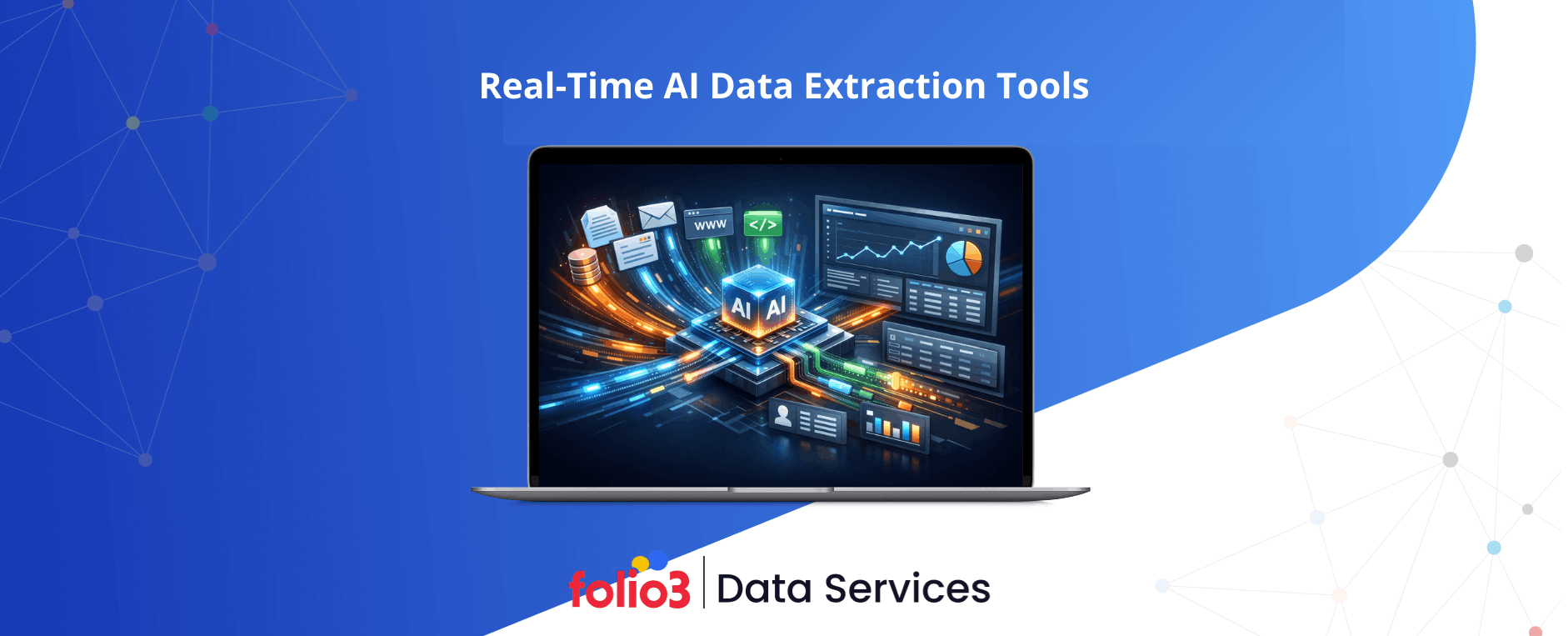

Real-time data extraction is the automated process of pulling structured data from sources like documents, websites, and APIs the moment it’s created or updated—so insights and actions aren’t delayed by batch schedules. Demand is rising as teams push for instant analytics and scalable automation; modern AI extractors increasingly deliver high accuracy and faster throughput, as highlighted in enterprise research on AI-driven automation and real-time analytics (McKinsey Global Institute – The value of real-time data and AI). For leaders asking which AI data extraction tool offers real-time capabilities, the answer is: several. The standouts to evaluate across industries such as finance, healthcare, logistics, and manufacturing are Folio3 Data, Hevo Data, Octoparse, Nanonets, Mindee, V7 Go, Procys, and Rows.
1. Folio3 Data
Folio3 Data is a consultative partner for end-to-end, real-time AI data extraction—designing, deploying, and operating production-grade pipelines on platforms like Snowflake and Databricks. Our teams unify fragmented sources across documents, web, and SaaS systems into a governed, low-latency architecture that accelerates decision-making and reporting. Through tailored solution design, proof-of-value pilots, and hands-on integration, we focus on measurable ROI, scaling from initial use cases to enterprise-wide rollouts. Supporting services include data governance and monitoring, reference architectures, MLOps, and AI strategy workshops. For an overview of our approach to streaming and low-latency warehousing, explore our perspective on real-time data integration.
2. Hevo Data
Hevo Data is a no-code, real-time ETL platform engineered for operational data integration. Its focus on low-latency pipelines reflects broader findings that real-time ETL improves decision velocity and analytics freshness in data-driven organizations (IBM Research – Real-time data integration for analytics). Its low-latency sync connects 150+ sources to cloud warehouses like Snowflake, BigQuery, and Redshift with minimal setup, making it a strong fit for teams that need reliable, near-instant data movement at scale, as noted in industry roundups of leading extraction tools.
ETL (Extract, Transform, Load) is the automated process of pulling data from source systems, transforming or cleaning it to align with business rules, and loading it into a target environment such as a data warehouse. The goal is consistent, analytics-ready data that can be trusted across reporting, dashboards, and downstream applications.
Quick comparison of real-time connector coverage (varies by connector and plan):
- Hevo Data: 150+ SaaS/database sources; database CDC; webhooks; Snowflake/BigQuery/Redshift destinations.
- Fivetran: Extensive SaaS/database coverage; incremental sync/CDC on many connectors; broad warehouse support.
- Airbyte (OSS/Cloud): Large community of connectors; CDC on selected sources; warehouse and lake destinations.
3. Octoparse
Octoparse is a visual AI web data extractor built for semi-structured sites. Its design mirrors academic findings that visual and AI-assisted web extraction tools significantly reduce manual effort when dealing with semi-structured online data sources (Springer – Automated web data extraction: techniques and challenges).
It offers point-and-click scraping, AI auto-detection of data fields, visual workflow design, IP rotation, and CAPTCHA solving for complex or protected sites—features commonly highlighted in expert tool comparisons. The tradeoff: it excels for web data, but performance can dip on heavily restricted sites, so compliance and site policies deserve attention. Common use cases include e-commerce price tracking, market research, lead generation, and competitive monitoring.
Supported web sources and export formats at a glance:
- Sources: Product listing pages, pagination-heavy catalogs, search results, directory listings, review pages, job boards.
- Outputs: CSV, Excel, JSON, API access, and direct export to Google Sheets.
4. Nanonets
Nanonets is a business-ready, no-code platform for high-volume business document automation and ERP integration. It streamlines extraction of structured fields from invoices, receipts, purchase orders, IDs, and more, with user-friendly model training and strong accuracy reported in independent reviews. Typical pricing signals indicate enterprise plans starting around $499/month. Core scenarios include AP automation, KYC verification, and claims processing, where automated data extraction is critical for reducing manual effort and speeding processing.
Relevant themes: business document automation, ERP integration, high-volume processing.
5. Mindee
Mindee is a developer-centric platform delivering real-time OCR and structured field extraction through clean APIs and SDKs. This API-first OCR model reflects research findings that combining OCR with contextual AI models improves extraction reliability in production systems (arXiv – Deep learning for document understanding).
OCR is an AI technique that turns images or scanned documents into machine-readable text and structured fields. It identifies characters, words, and layout regions, then normalizes them so they can be searched, validated, and used by downstream systems without manual retyping.
Mindee supports receipts, invoices, passports, and IDs using deep learning, with flexible free and pay-as-you-go tiers referenced in trusted evaluations. Integration options include REST APIs and popular SDKs for rapid embedding into apps and workflows, showcasing how AI in Data Engineering is being used to streamline document pipelines and reduce manual preprocessing.
6. V7 Go
V7 Go provides multi-modal, generative AI extraction for complex documents—including handwriting, stamps, and mixed layouts. It layers implicit OCR with advanced parsing, supports human-in-the-loop quality assurance, and transforms large unstructured files into searchable indexes for discovery and analytics—capabilities highlighted in contemporary tool guides.
Human-in-the-loop is a quality assurance pattern where people review or approve AI outputs to correct edge cases, resolve low-confidence fields, and enforce business rules. The result is higher precision on messy or novel inputs while keeping throughput high for routine cases.
Compared with standard OCR solutions:
- V7 Go: Implicit OCR + layout/semantic parsing, HITL queues, configurable confidence thresholds, and dataset versioning.
- Standard OCR: Text-only extraction with rules/regex; limited context understanding; manual QA outside the tool.
7. Procys
Procys is an enterprise-grade AI extraction engine with deep ERP, CRM, and accounting integrations. It emphasizes custom field mapping, high-throughput processing, and validation queues with audit logs. Procys cites up to a 6× speed advantage over manual workflows for document-heavy processes, aligning with broader market benchmarks on AI-driven gains. Integrations commonly include SAP, NetSuite, Microsoft Dynamics, Sage, QuickBooks, Xero, and Salesforce. Pricing typically shifts to custom plans at large volumes or when strict SLAs are required.
How to Evaluate Real-Time AI Data Extraction Tools
Use this 5-step flow to pilot confidently:
- Define representative document/web/API samples and expected fields.
- Run pilots with free tiers or trial credits against those samples.
- Benchmark accuracy, latency, and throughput under realistic loads.
- Review integration, governance, and quality controls (validation queues, audit trails).
- Project total cost at required scale, including remediation and support.
Prioritize category fit (document/web/pipeline), connector breadth, and operational controls before scaling. This flow applies equally to intelligent document processing platforms, web extraction tools, and pipeline-based solutions.
Key Features to Consider
Core capabilities to seek:
- AI-driven field extraction combining OCR and NLP
- Real-time data flow with streaming/webhooks
- Validation workflows, auditability, and monitoring
- Post-processing: normalization, enrichment, and deduplication
- Role-based access control and PII handling
NLP (Natural Language Processing) enables software to understand, interpret, and process human language in context. In extraction, NLP disambiguates entities, relates fields (e.g., totals vs. taxes), and handles synonyms and varied wording so outputs are both accurate and analysis-ready.
For RFPs:
- Does the tool support OCR + NLP-based contextual extraction?
- Can it run in real time with streaming or webhooks?
- Are validation queues, confidence scores, and audit logs built in?
- Does it support custom schemas, enrichment, and transformations?
- What governance, monitoring, and role controls are available?
Integration and Connectivity
Fast connectivity to warehouses, ERPs, and CRMs determines time-to-value. Look for database connectors, webhooks, and live spreadsheet integrations that keep operational reporting current, especially when feeding downstream tools like Snowflake Document AI for advanced document processing and analytics.
Integration ecosystem snapshot:
| Tool | Primary category | Notable integrations/connectors |
| Folio3 Data | Consulting + integration | Snowflake, Databricks, Azure Synapse, Kafka |
| Hevo Data | Real-time ETL | Snowflake, BigQuery, Redshift; 150+ SaaS/DB sources |
| Octoparse | Web scraping | CSV, Excel, JSON, Google Sheets, API export |
| Nanonets | Document AI | SAP, NetSuite, QuickBooks, Xero (via webhooks/REST) |
| Mindee | OCR API | REST + SDKs; webhooks; object storage targets |
| V7 Go | Multimodal doc AI | S3/GCS/Azure Blob; webhooks; MLOps-friendly |
| Procys | ERP-centric doc extraction | SAP, NetSuite, Microsoft Dynamics, Salesforce |
Accuracy and Scalability
With AI+NLP+OCR, leaders can expect 98–99% accuracy on clean documents and throughput that’s 6–10× faster than manual entry, consistent with current pattern analyses and vendor-reported outcomes. At scale, validation queues, human-in-the-loop review, confidence thresholds, and error remediation workflows preserve data quality. Rule-based OCR can handle simple, fixed layouts, but AI-powered contextual extraction adapts to variable templates and noisy inputs with far higher reliability.
Ease of Use and Automation
Different teams need different entry points—developer APIs, no-code dashboards, or natural-language interfaces. Automation reduces manual entry, supports scheduling and event triggers, and provides workflow templates to standardize reviews and exports.
Usability and automation snapshot:
| Tool | Primary users | Interface | Automation highlights |
| Hevo Data | Data engineers | No-code + SQL | Scheduling, CDC, alerts, in-flight transforms |
| Octoparse | Ops/analysts | Visual designer | Auto-scheduling, proxies, retries |
| Nanonets | Finance/Ops | No-code UI | Rules, approvals, ERP sync |
| Mindee | Developers | API/SDKs | Webhooks, event-driven processing |
| V7 Go | Data/Ops teams | UI + API | HITL queues, confidence thresholds |
| Procys | Finance/IT | UI + API | Validation queues, audit logs |
| Rows | Business teams | Spreadsheet UI | Live formulas, AI functions, refresh |
Pricing and Total Cost of Ownership
Expect free trials or entry tiers in the $75–$499/month range, with custom quotes for large-scale or SLA-driven deployments in enterprise contexts. Total cost of ownership is the all-in investment over the tool’s lifecycle, including subscription, integrations, infrastructure, training, support, and the cost of remediating false positives or handling edge cases at scale. Model costs against document volume, expected error rates, support SLAs, and future expansion to additional data types or geographies.
Frequently Asked Questions
What Are Real-Time AI Data Extraction Tools?
They use AI to automatically convert unstructured sources—documents, web pages, images—into structured data as events happen, delivering instant inputs for analytics and operations.
How Do These Tools Improve Business Efficiency?
They eliminate manual data entry, reduce errors, and deliver insights up to 6× faster, enabling teams to focus on higher-value analysis and decision-making.
Which Types of Data Can AI Extraction Handle?
Text from PDFs and scans, emails, images, complex web pages, and transactional records from APIs or cloud platforms.
What Should I Look For in a Trial or Pilot?
Test accuracy, speed, integration ease, and automation features on representative samples before committing to scale.
How Does Human-in-the-Loop Enhance Accuracy?
It lets people review or verify low-confidence fields, boosting reliability on complex or noisy inputs without slowing routine processing.
Conclusion
Real-time AI data extraction is becoming essential for businesses that need fast, accurate, and scalable data to support modern workflows. When extraction happens instantly, organizations can automate processes, improve data quality, and make faster decisions without waiting for batch updates. The best tool depends on your specific needs, but the platforms listed here represent strong options to evaluate for real-time extraction across industries such as finance, healthcare, logistics, and manufacturing.
Folio3 Data Services helps businesses build and manage real-time AI extraction systems that deliver reliable results at scale. Our team designs end-to-end pipelines on platforms like Snowflake and Databricks, connecting documents, web sources, and SaaS applications into a governed, low-latency architecture. From pilot to enterprise deployment, we provide the integration, monitoring, and support needed to ensure extraction is accurate, compliant, and ready for real-time automation and analytics.