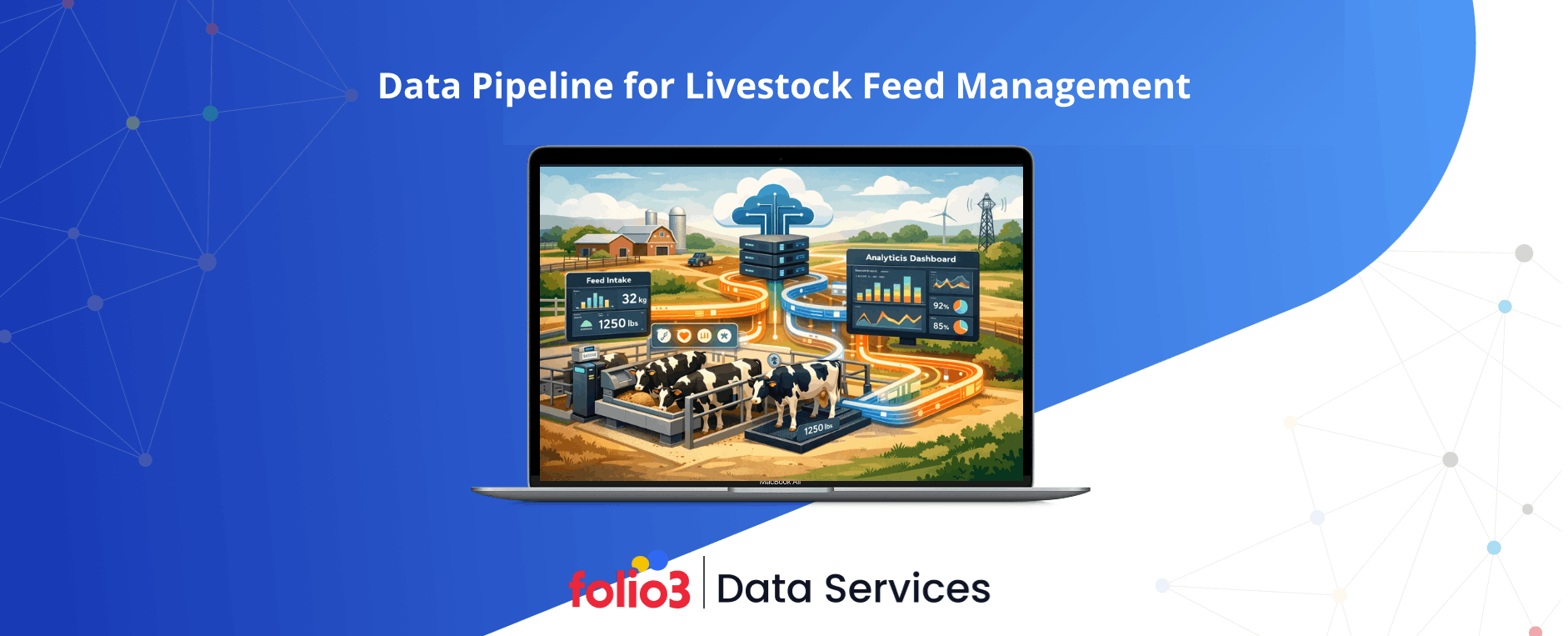

Fragmented farm systems, siloed lab results, and intermittent connectivity make livestock feed data hard to trust and harder to scale. If you’re aiming for precision livestock farming, the fastest path to better rations, healthier herds, and lower costs is a unified analytics foundation that handles IoT data integration and supports both batch and real-time pipelines. Below we outline the seven essential data pipeline services our team sees delivering the most impact in livestock feed management—what they do, where they fit, and how to combine them for resilient, compliant operations.
A data pipeline is the engineered path that moves, transforms, and validates data from source systems to analytics destinations so it’s complete, timely, and ready for decision-making.
1. Folio3 Data: Empowering Livestock Feed Data Pipelines
Senior data leaders choose Folio3 Data to modernize feed analytics with end-to-end pipeline design, cloud-native execution, and a consultative delivery model. Our teams build scalable, secure, and compliant architectures across Snowflake, Databricks, and BigQuery, unifying telemetry from feed bins and mixers, rationing apps, weather APIs, lab assays, and ERP/fulfillment systems into auditable models for real-time decisions and regulatory reporting.
We specialize in data modernization and legacy system transformation, layering observability, lineage, and governance from day one. The result is actionable insights that connect ration planning to outcomes—intake, ADG, FCR, and cost per head—while meeting feed traceability and privacy requirements. For a sense of our approach to visibility at scale, explore our agricultural supply chain visualization guide.
2. Apache Airflow for Workflow Orchestration
Workflow orchestration automates the end-to-end sequencing, scheduling, and monitoring of data flows, ensuring reliable execution and clear lineage for all pipeline tasks. Airflow is a leading engine to author, schedule, and monitor intricate pipelines—well-suited to conditional steps like “load latest feed tests, validate quality thresholds, then trigger purchase orders”—with strong visibility and dependency management, as summarized in Matillion’s overview of pipeline tools.
Where it shines: auditable, multi-step jobs, SLA-driven retries, and governance of complex DAGs (e.g., ration optimization followed by alerts and inventory updates). Tradeoff: it requires engineering investment to operate and is best when you need custom logic at enterprise scale.
3. AWS Glue for Serverless ETL and Integration
ETL (Extract, Transform, Load) is the process of collecting data from multiple sources, converting it into a common format, and loading it into a central analytics store. AWS Glue provides serverless ETL with automatic provisioning, a built-in Data Catalog, and pay-only-for-runtime pricing—supporting both scheduled batch and streaming jobs, which keeps costs proportional to usage as feed volumes fluctuate. In practice, Glue can enforce task dependencies (for example, ensuring lab moisture/protein results land before ordering routines run) and deliver fault-tolerant processing to keep nightly reconciliations on track, an approach echoed in K21Academy’s AWS data pipeline guide.
4. Apache NiFi for Edge Ingestion and IoT Dataflows
Edge ingestion refers to capturing and pre-processing data as close as possible to its source—such as farm sensors—to ensure resilience and minimize latency. Apache NiFi excels here with drag-and-drop data flows, local buffering, back-pressure, and agent-based collection that rides through rural network outages. For livestock operators, NiFi helps normalize telemetry from feed bins, scales, and mixer trucks; enriches data with site metadata; and streams it promptly to cloud analytics, enabling low-latency feed controls and automated animal health alerts. Its emphasis on automation and reliability aligns with Softweb Solutions’ automation brief on pipeline-driven transformation.
5. Fivetran for Fully Managed ELT and Connector Coverage
ELT (Extract, Load, Transform) reverses the traditional ETL sequence by first loading raw data into a storage platform, then transforming it in place—accelerating integration for modern cloud analytics. Fivetran’s value is its fully managed connectors and automated maintenance across a large library (700+ connectors), combined with a cloud-first, pay-as-you-go model, as outlined in Fivetran’s best tools guide. It’s strong for integrating farm ERPs, accounting, procurement, and e-commerce with minimal ops. Key tradeoff: it’s not designed for true sub-minute real-time; fastest syncs are typically around five minutes—fine for most logistics and cost workflows, less so for second-by-second feed controls.
6. Estuary for Unified CDC and Streaming Pipelines
Change Data Capture (CDC) identifies and propagates only the changes made in a source system, minimizing data transfer and enabling near real-time synchronization. Estuary unifies CDC, streaming, and ELT in one platform with 200+ connectors, no-code/low-code flows, and predictable volume-based pricing, making it well suited for building a reliable streaming data pipeline when low latency and cost stability matter across seasons. Security options like VPC Peering, PrivateLink, and encryption in transit and at rest are a fit for regulated feed and animal health data. See Estuary’s 2023 tools guide for an overview of its unified model and controls.
7. Airbyte for Open-Source Connector Flexibility
Airbyte’s open-source core and 600+ connectors give data teams deep control across hybrid, on-premises, and cloud deployments. For organizations running niche lab systems, mill software, or bespoke ranch tools, Airbyte’s Connector Development Kits (CDK) and CDC support enable rapid, tailored integrations without waiting on vendor roadmaps. Consider total cost of ownership: open-source trims license costs but requires engineering capacity for operations, scaling, and monitoring.
Google Cloud Dataflow for Scalable Stream and Batch Processing
Batch pipelines process large data groups at intervals, while streaming pipelines process incoming data instantly for real-time analysis. Dataflow, built on Apache Beam, is a fully managed service that auto-scales for both modes, making it a strong choice if your feed analytics live on Google Cloud. A common pattern pairs streaming for real-time rationing alerts (e.g., out-of-tolerance intake spikes) with batch for long-term feed cost analysis and supplier performance—within one codebase and runtime.
Recommended Architecture Patterns for Livestock Feed Management
A resilient architecture blends edge robustness with cloud-scale analytics and governance. Consider this reference workflow:
- Edge ingestion: NiFi/agents buffer and normalize sensor and mixer data on-farm.
- Streaming/CDC: Dataflow or Estuary moves high-priority events and change streams with low latency.
- Managed ELT: Fivetran or Airbyte consolidates business systems (ERP, procurement, accounting).
- Transform/model: Databricks/Snowflake/BigQuery standardize feed facts, dimensions, and quality metrics, supporting better agricultural supply chain visualization for operations and reporting.
- Orchestration: Airflow coordinates dependencies, SLAs, and corrective retries.
- Integration/ETL: AWS Glue runs serverless transforms where AWS-centric workloads dominate.
Table: Example end-to-end flow
| Step | Primary tools | Purpose |
| 1. On-farm capture | NiFi/agents | Buffer, normalize IoT telemetry; survive outages |
| 2. Low-latency movement | Dataflow/Estuary | Stream events and CDC to cloud |
| 3. System consolidation | Fivetran/Airbyte | Sync ERP, lab, ordering, and finance |
| 4. Storage/compute | Snowflake/Databricks/BigQuery | Central models for feed KPIs |
| 5. Orchestration | Airflow | Enforce order, SLAs, lineage |
| 6. Serverless ETL | AWS Glue | Cost-efficient transforms and loads |
Overlay observability (logs, metrics, lineage, SLA alerts) and security controls (SOC 2, GDPR, encryption) across the stack. Combining managed and open-source components balances farm resiliency, connector breadth, and cloud-scale economics.
Practical Tradeoffs When Choosing Pipeline Services
- Managed services (Fivetran, Estuary, Glue): faster time-to-value and lower ops burden, with predictable SLAs; costs can climb at petabyte scale or with extreme fan-out.
- Open-source (Airflow, NiFi, Airbyte): maximum control and extensibility with lower license costs; requires dedicated engineering for reliability, upgrades, and security.
Industry results show that automating cloud data pipelines can cut analytics costs by up to 40%, according to DataForest’s market leaders roundup—though savings depend on scale, architecture fit, and governance maturity. Prioritize low-latency ingestion for animal health, broad connector coverage for farm systems, offline resiliency at the edge, and predictable SLAs for compliance and traceability.
Frequently Asked Questions
What are the key factors to consider when selecting data pipeline services for livestock feed management?
Focus on real-time versus batch needs, connector compatibility, data security, offline resiliency, and predictable cost/SLA models.
How do real-time and batch processing differ in livestock feed data pipelines?
Real-time supports immediate alerts for intake, equipment, and health; batch is ideal for scheduled inventory, cost analysis, and regulatory reports.
What role does edge resiliency play in managing farm data pipelines?
It buffers and validates data locally so operations continue and no telemetry is lost during network interruptions.
How can data pipeline observability improve livestock feed traceability and compliance?
It exposes data flow, lineage, and failure points for rapid troubleshooting and auditable proof of feed handling and quality checks.
What security standards are important for livestock feed management data?
SOC 2, GDPR, and HIPAA where applicable, plus encryption in transit/at rest and hardened network paths (e.g., private links).
What services does Folio3 Data offer for livestock feed management data pipelines?
Folio3 Data provides end-to-end services tailored to livestock feed management, including IoT/edge ingestion (Apache NiFi/agents), real-time streaming and CDC (Google Cloud Dataflow, Estuary), managed and open-source ELT (Fivetran, Airbyte), serverless ETL (AWS Glue), and workflow orchestration (Apache Airflow)—all unified on Snowflake, Databricks, or BigQuery. We layer observability, lineage, and governance from day one and deliver secure, compliant architectures that connect ration planning to outcomes (intake, ADG, FCR, cost per head) with reliable feed traceability and regulatory reporting.
Conclusion
Building reliable, scalable data pipelines is no longer just a technical task; it is a critical driver of efficiency, animal health, and profitability in modern livestock feed management. When IoT, lab, ERP, and operational data flow seamlessly from edge to cloud, feed decisions become faster, more accurate, and fully traceable, turning fragmented farm data into actionable insights.
Folio3 Data Services helps livestock operators achieve this by designing and managing end-to-end data pipelines that balance real-time responsiveness, batch analytics, and regulatory compliance. From edge ingestion and streaming to managed and open-source ELT, workflow orchestration, and observability, we provide the architecture, tools, and expertise to make data work for you. Whether the goal is healthier herds, optimized rations, or cost savings, we help turn complex farm data into a reliable foundation for measurable growth.