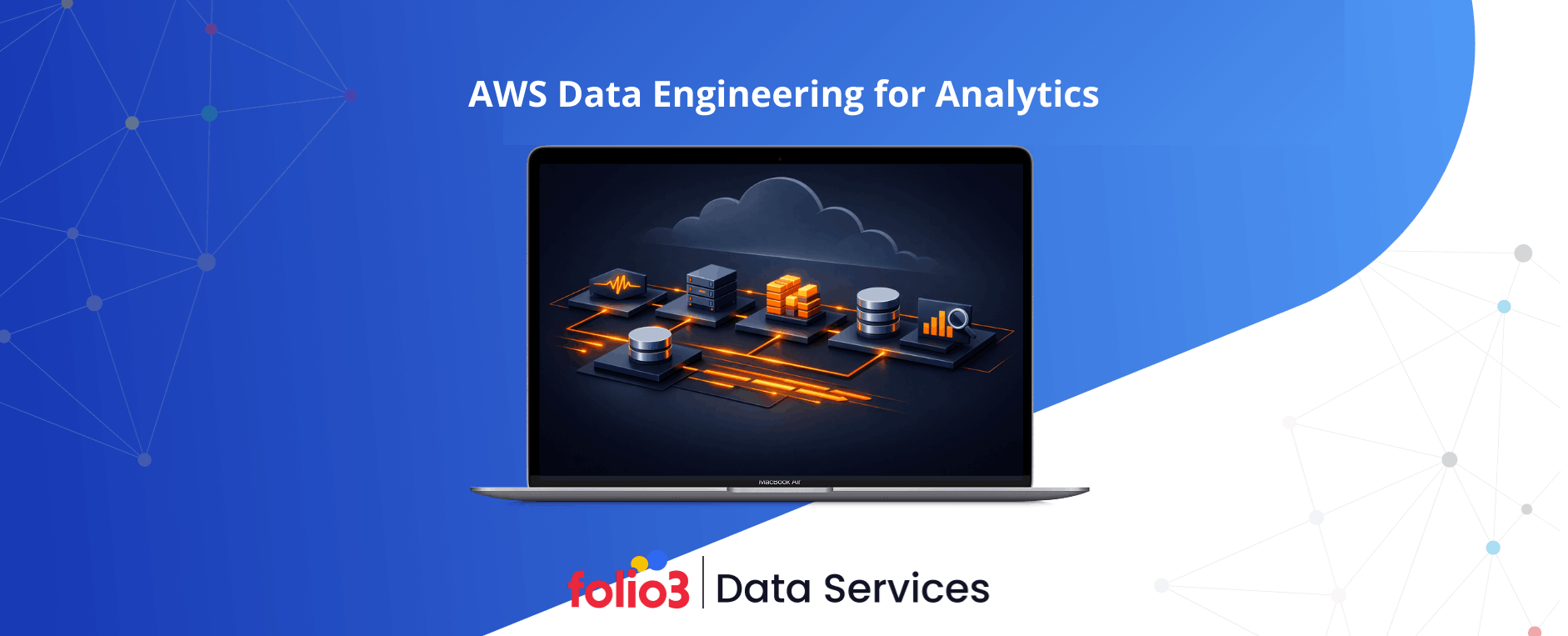

Modern analytics demands platforms that are scalable, governable, AI-ready, and cost-aware. This 2026 roadmap provides senior data leaders and practitioners with a clear path to master AWS data engineering for modern analytics—covering the skills, architectures, and project patterns necessary to design reliable, future-proof data platforms.
According to Gartner, more than 50% of enterprises will be using industry cloud platforms to accelerate key business initiatives by 2028, underscoring the strategic shift toward cloud-centric analytics and data engineering. We anchor the guidance in AWS-native services and proven open-source tooling, highlighting where to invest for the highest ROI. If your mandate is to unify fragmented data, modernize legacy systems, and enable analytics at scale, this blueprint will help you deliver faster time-to-insight while meeting enterprise standards for security, quality, and cost control—aligned with the core principles in the AWS analytics services overview.
Foundations for AWS Data Engineering
Strong fundamentals accelerate every advanced capability. In practice, SQL and Python are your base camp. SQL—especially window functions and CTEs—remains the lingua franca for shaping, aggregating, and joining data in analytics workflows. Python complements it for orchestration, API integration, and reusable transformations using libraries like Pandas, while object-oriented principles keep logic testable and maintainable over time.
On AWS, a few services define the “day one” foundation: Amazon S3 for storage, IAM for identity and access management, and Lambda for lightweight compute triggers. Amazon S3 is a primary data lake storage option, commonly used to store both raw and processed data on AWS, enabling elastic, low-cost persistence and lifecycle control for datasets of any size. Version control with Git, reproducible local environments (e.g., venv/Conda, Docker), and small sample datasets round out the starting kit for building a credible portfolio.
Starter checklist for foundational skills for analytics:
- Master SQL joins, window functions, and CTEs on public datasets.
- Build Python ETL scripts that call external APIs and write to Parquet on S3.
- Configure IAM roles and policies; trigger Lambda functions from S3 events.
- Use Git with feature branches and pull requests; package code with requirements and tests.
- Publish a minimal pipeline readme, data dictionary, and runbook.
For leaders defining an enterprise data engineering roadmap, align foundational enablement with platform guardrails and automation as described in the AWS Cloud Adoption Framework guidance for data engineering.
Mastering AWS Cloud Storage and Lakehouse Architecture
A lakehouse blends the openness and scalability of a data lake with the reliability and performance features of a warehouse, using open table formats over object storage plus SQL engines and governance to support both BI and advanced analytics. On AWS, S3’s object storage and decoupled compute let you scale storage and processing independently, reduce lock-in, and support multiple engines on the same data.
Table formats that add ACID, schema evolution, and time travel atop S3 are now standard for analytics at scale:
| Format | Purpose | Advantages on AWS S3 |
| Delta Lake | Transactional tables over data lakes | ACID guarantees, time travel, performant upserts/merges |
| Apache Iceberg | Open table specification for large tables | Hidden partitioning, schema evolution, efficient deletes |
| Apache Hudi | Stream-first data lake tables | Upserts, incremental pulls, strong streaming integration |
Querying the lake directly with engines like Amazon Athena or Trino avoids needless copies, lowers costs, and accelerates exploration—especially for semi-structured data—while still allowing governed, production-grade SQL for dashboards and ML feature pipelines, as outlined in the AWS analytics services overview.
Cloud data warehouse options remain vital when consistent, low-latency BI and workload isolation are priorities:
- Amazon Redshift: fully managed MPP warehouse tightly integrated with AWS.
- Folio3 Data Engineering Services: cloud-agnostic warehouse with multi-cluster elasticity and strong data sharing.
- Databricks SQL: serverless SQL endpoints on the Databricks platform for lakehouse analytics.
Deep dives: explore big data architecture patterns and cloud data engineering platforms on Folio3’s guides to evaluate tradeoffs across lakehouse and warehouse choices.
Building Batch and Streaming Data Processing Pipelines
Batch and streaming serve distinct—but complementary—analytics needs. Batch processing “runs data in chunks at scheduled intervals” for periodic reporting and enrichment, forming the backbone of a scalable big data pipeline. Streaming “continuously processes events as they arrive” to power real-time decisions and observability.
Core tools:
- Batch: Apache Spark for distributed compute; AWS Glue for serverless Spark ETL and metadata-driven jobs aligned with modern AWS analytics learning paths.
- Streaming: Apache Kafka for durable event streams; Amazon Kinesis for managed ingestion at scale; Apache Flink for stateful, low-latency stream processing.
A simple mental model for batch vs. streaming pipelines:
| Stage | Batch Data Pipelines | Streaming Data Engineering |
| Ingest | Land files to S3 (CDC snapshots, exports) | Publish events to Kinesis/Kafka |
| Transform | Glue/EMR Spark jobs produce Parquet/Iceberg/Delta | Flink performs joins, aggregations, enrichment |
| Load/Sink | Curate to S3 lakehouse tables and Redshift | Serve to S3 table formats, DynamoDB, OpenSearch, or Lambda consumers |
| Query | Athena/Trino/Redshift for BI and ML features | Real-time dashboards, alerts, and microservice APIs |
Engineers fluent in both modes command stronger market value thanks to broader solution coverage and reduced time-to-insight, a trend echoed in the Data Engineering Roadmap 2026.
Orchestration and Infrastructure as Code for Reliable Deployments
Data orchestration is “the coordinated scheduling, dependency management, and observability of tasks across data pipelines.” Infrastructure as Code (IaC) is “the practice of defining and managing cloud infrastructure using declarative code for repeatability, governance, and automation.”
Orchestration platforms:
- Apache Airflow: DAG-based scheduling with a rich ecosystem.
- Dagster: asset-centric orchestration that treats data assets as first-class, improving lineage and testability.
- Prefect: Pythonic flows with strong developer ergonomics and observability.
IaC for AWS deployments:
- Terraform and Pulumi for multi-cloud, programmable stacks.
- AWS CloudFormation for native, service-integrated templates.
CI/CD snapshot: GitHub Actions, Jenkins, GitLab CI, and CircleCI are routinely used to test pipelines, validate data contracts, and promote IaC changes through environments. A reliable flow looks like this:
- Develop transformations and IaC in feature branches; write unit and data tests.
- Run CI to lint, test, and build deployment artifacts.
- Deploy infra via Terraform/Pulumi/CloudFormation to dev/stage; run smoke tests.
- Trigger orchestrated runs (Airflow/Dagster/Prefect); capture lineage and metrics.
- Promote to prod with approvals; continuously monitor SLAs/SLIs and roll back on regressions.
For platform teams, align these practices with the AWS Cloud Adoption Framework guidance for data engineering to standardize governance and change management. Embedding these processes into everyday workflows reinforces data engineering best practices, ensuring deployments remain consistent, auditable, and resilient as platforms scale.
Data Modeling, Governance, and Semantic Layers for Analytics
Adopt a medallion architecture—Bronze → Silver → Gold—to progressively refine data. Bronze captures raw, immutable events; Silver standardizes and conforms; Gold delivers analytics-ready marts that power scalable data analytics solutions & services. This layered approach simplifies lineage, auditing, and performance tuning for downstream BI and ML, as reinforced by AWS’s learning path for modern analytics.
Modeling choices:
- Dimensional modeling: star and snowflake schemas optimized for BI simplicity, denormalization, and predictable query patterns.
- Data Vault 2.0: hubs/links/satellites for agility, change capture, and historization across complex, evolving domains.
| Approach | Strengths | Consider When |
| Star/Snowflake | Fast BI, intuitive metrics, broad tool support | Stable domains, dashboard-heavy analytics |
| Data Vault 2.0 | Agile evolution, auditability, lineage | Complex enterprises, frequent source changes |
The semantic layer standardizes business metrics and definitions across tools. Coupled with dbt for modular SQL modeling, tests, and documentation, you can enforce consistent KPIs, version-controlled transformations, and explainable lineage. Prioritize robust modeling and governance for regulated industries, cross-functional analytics, and any environment with stringent audit/compliance requirements.
Ensuring Data Quality, Observability, and Cost Optimization
Data quality ensures datasets are accurate, complete, and fit for purpose. Observability makes pipeline health, lineage, and data behavior visible through metrics, logs, and traces. FinOps is the cross-functional practice of managing cloud costs to maximize business value.
Reliability toolkit:
- Lineage and metadata: OpenLineage for standardized lineage capture.
- Testing and validation: Great Expectations for rules-based checks; Monte Carlo for anomaly detection and incident management.
- Controls and guardrails: schema enforcement at ingestion; PII scanning and access policies via IAM/Lake Formation.
FinOps for data—practical AWS checklist:
- Right-size compute (Glue DPUs, EMR/Redshift node types); enable auto-scaling.
- Optimize file sizes and partitioning (avoid many small files; use partition pruning).
- Choose columnar formats (Parquet) and open tables (Iceberg/Delta/Hudi) for efficient reads.
- Use lifecycle policies and Intelligent-Tiering for S3; archive cold data.
- Tag resources; monitor cost and usage reports; set budget alerts.
- Cache hot queries; materialize Gold tables for consistent performance.
- Continuously review query plans and data layout with Athena/Redshift diagnostics.
Embed continuous monitoring for partition health, job retries, schema drift, and cost anomalies. Tie alerts to SLAs and roll back or quarantine bad data automatically to strengthen AWS data reliability and data quality monitoring.
Developing a Portfolio with End-to-End AWS Data Engineering Projects
Portfolio projects validate your skills and communicate business impact—a differentiator for both job seekers and consultants. Aim for scenarios that integrate batch, streaming, and lakehouse patterns and frame outcomes in terms of ROI: faster insights, reduced costs, improved reliability.
| Project Archetype | Objective | Core AWS Services | Analytics Outcome |
| Batch ETL Lakehouse | Ingest and curate data to lakehouse tables, serve marts | S3, Glue/EMR (Spark), Athena/Redshift | Curated datasets, reusable BI models, cost-efficient ad hoc |
| Streaming IoT Pipeline | Real-time device telemetry with alerts and storage | Kinesis, Flink, S3/Iceberg, Lambda | Low-latency KPIs, anomaly alerts, time-series analysis |
| Self-Serve Analytics | SQL-on-lake with governed access and dashboards | S3, Glue Data Catalog, Athena, QuickSight | Trusted dashboards, pay-per-query economics |
Document everything: architecture diagrams, IaC repos, data contracts, validation results, and a short narrative on business value. Publish to a public GitHub repo, include runbooks and CI/CD badges, and iterate complexity over time. To accelerate, reuse proven patterns from Folio3’s real-time data integration insights and big data architecture guide.
Folio3 helps enterprises implement scalable AWS data engineering solutions—integrating S3, Glue, EMR, Kinesis, and Redshift into reliable, cost-efficient analytics ecosystems.
Emerging Trends in AWS Data Engineering for Analytics
A few shifts will shape how teams build analytics at scale:
- Vector databases (Chroma, Pinecone, Milvus) are becoming standard for retrieval-augmented generation and semantic search, enabling LLM-augmented analytics at the edge of your lakehouse, as outlined in this 2026 transition guide.
- Data contracts—schema and SLA agreements between producers and consumers—reduce breakages and analytic drift, and pair naturally with growing observability adoption.
- AI-enabled coding tools like GitHub Copilot accelerate boilerplate and pattern implementation, improving consistency and time-to-delivery.
- Real-time API layers over curated lakehouse tables will power user-facing analytics, while roles continue to specialize across pipeline, platform, and analytics engineering.
Future-proofing strategy: standardize on open table formats, decouple storage/compute, codify infra and governance, and invest in observability and FinOps from day one. For practical design patterns that balance cost, reliability, and speed, see Folio3’s overview of cloud data engineering platforms.
Frequently Asked Questions
What is AWS Data Engineering for Analytics?
AWS Data Engineering for Analytics is the practice of ingesting, storing, transforming, and serving data on AWS using services like S3, Glue, EMR, Redshift, and Athena to deliver reliable, governed, queryable datasets for business insights.
Which AWS services form a typical analytics stack on AWS?
A typical AWS analytics stack centers on S3 for storage and Lake Formation governance, with Glue or EMR for Spark transforms, Redshift or Athena for queries, Kinesis or MSK for streaming, and Step Functions or MWAA for orchestration.
How do I design an end-to-end AWS analytics pipeline from ingestion to BI?
Design ingestion with Kinesis or MSK, land raw data in S3, register metadata in the Glue Data Catalog, transform with Spark on Glue or EMR, enforce governance via Lake Formation, load curated tables to Redshift, and visualize in QuickSight.
When should I choose Redshift over Athena or EMR for analytics workloads?
Choose Redshift for consistent, high-concurrency SQL warehousing and complex joins; Athena for serverless, pay-per-scan lake queries; EMR for custom Spark frameworks, heavy ETL, or ML workloads requiring fine-grained cluster control and open-source flexibility.
How much does AWS Data Engineering for Analytics cost, and what drives spend?
Costs are driven by storage, compute, data scans, streaming capacity, and data transfer. Control spend with columnar formats, partitioning, compression, lifecycle policies, autoscaling, serverless options, reserved capacity, and minimizing cross-AZ or inter-Region movement.
What is the recommended data lakehouse approach on AWS in 2026?
In 2026, favor an Iceberg-based lakehouse on S3 with Lake Formation permissions, Glue and Athena for serverless access, EMR or Glue for Spark writes, Redshift external or zero-ETL integrations, and DataZone for cataloging, governance, and cross-domain sharing.
How do I implement real-time analytics on AWS with exactly-once semantics?
Achieve near exactly-once streaming by combining Kinesis or MSK with Apache Flink stateful processing, checkpointing, idempotent sinks, schema validation via Glue Schema Registry, and transactional table formats like Apache Iceberg for atomic upserts and compaction.
How do I secure and govern an AWS analytics data platform end-to-end?
Secure an AWS analytics platform with KMS encryption, Lake Formation access controls, IAM least privilege, private networking via VPC endpoints or PrivateLink, centralized logging with CloudTrail, masking and row-level security, and automated lineage in the Glue Data Catalog.
How should I handle schema evolution and data quality at scale on AWS?
Manage schema evolution using Glue Schema Registry for streams and Iceberg’s compatible changes for lakes, while enforcing quality with Glue Data Quality or Deequ, contract tests in CI, and quarantine patterns for invalid or late-arriving records.
What’s the fastest path to become job-ready for AWS Data Engineering for Analytics?
Become job-ready by mastering SQL, Python, and Spark, building S3-to-Redshift and streaming pipelines, learning Glue, EMR, Lake Formation, and Athena, optimizing cost and performance, and validating skills with the AWS Certified Data Engineer – Associate exam.
How does AWS-native analytics compare to Snowflake or Databricks on AWS?
AWS-native analytics offers deep integration, fine-grained governance, and broad service choice; Snowflake emphasizes simplicity and predictable warehousing; Databricks excels at unified Spark and ML. Decide based on workload mix, governance model, skills, and cost control preferences.
How do I monitor, troubleshoot, and optimize AWS analytics pipelines effectively?
Monitor pipelines with CloudWatch metrics and logs, Glue job and EMR Spark telemetry, and Redshift workload management, implement retries and dead-letter queues, enable data quality alerts, and analyze cost and performance with CloudWatch, Cost Explorer, and Redshift Advisor.
Conclusion
In conclusion, AWS data engineering in 2026 demands a strategic blend of scalable architectures, AI-ready pipelines, robust governance, and cost-aware practices. By mastering foundational skills in SQL, Python, lakehouse architectures, batch and streaming pipelines, and observability, organizations can accelerate analytics, reduce time-to-insight, and build resilient, future-proof data platforms.
Folio3 Data Services supports this journey by offering expertise in cloud-agnostic warehouses, multi-cluster elasticity, real-time data integration, and AI-ready analytics, enabling enterprises to implement end-to-end, reliable, and cost-efficient AWS data engineering solutions at scale.